Journal of Korea Water Resources Association. 31 December 2016. 961-969
https://doi.org/10.3741/JKWRA.2016.49.12.961

ABSTRACT


MAIN

  • 1. 서 론

  • 2. 이론적 배경 및 차원해석

  • 3. 실험준비 및 방법

  • 4. 실험결과

  •   4.1 자유흐름 조건

  •   4.2 잠긴흐름 조건

  • 5. 결 론

1. 서  론

고정보는 하천에 가장 많이 설치되어 있는 하천구조물 중 하나로써 각종 용수의 취수, 주운 등을 위하여 수위를 높이고 조수의 역류를 방지하기 위하여 하천의 횡단방향으로 설치하며 제방의 기능을 갖지 않는 시설로 정의된다( Korea Water Resources Association, 2005). 그러나 최근 들어 환경적인 측면을 고려한 저낙차형 구조물 설치가 요구되면서 고정보의 형태도 다양하게 제안되고 있다. 저낙차형보를 제안하고 있는 하천은 대부분 중소하천이며, 중소하천의 경우 유량계측이 이루어 지지않는 경우가 많다. 보는 일반적으로 물을 담는 목적과 수면경사를 조절하는 기능으로 주로 활용되고 있지만 구조물 주변 흐름에서 한계류가 발생하므로 이론적으로 유량을 측정할 수 있는 기능이 추가된다. 본 연구는 중소하천의 설치된 보를 이용한 유량계측의 가능성을 도출하기 위한 목적으로 국내 중소하천에 주로 설치되어 보 형태를 대상으로 진행되었다.

고정보에 대한 기존 연구는 보 주변 흐름특성과 유량계수 산정을 위한 실험적 연구로 진행되었고 주로 흐름특성을 중심으로 수행되었다. 고정보의 연구의 경우 2000년대 초반까지 대부분 보 하류부에 대한 세굴이나 세굴 방지를 위한 목적의 연구가 대부분이다( Bormann and Julien, 1991; Song et al., 1994; Rice et al., 1998; Kim et al., 2003). 유량계수에 대한 연구의 경우 Borghei et al. (1999)이 고정보의 높이, 상류수심 등을 고려한 유량계수식을 산정하고 유량계수 영향인자에 대한 민감도 분석을 실시하였다. 또한 보 형태에 따라 잠긴 흐름 발생 시 수위-유량 관계를 분석한 연구는 과거부터 최근까지 진해되고 있다( Villemonte, 1947; Falvey, 2002; Borghei et al., 2003). 최근에는 다양한 형태에 대한 유량계수 연구가 활발히 진행되었는데 수중 래버린스 보(labyrinth weir)의 수리모형실험을 통해 수위 유량 관계곡선을 분석한 연구가 수행되었으며( Tullis et al., 2007) 경사형 보에 대한 유량계수 산정식을 제시한 연구가 수행되었다( Zerihun and Fenton, 2007; Hossein and Sara, 2010). Kabiri-Samani and Javaheri (2012)는 PKW (Piano Key Weirs)의 다양한 형태에 대해 수리모형실험을 수행하여 유량계수를 산정하였다. 국내 연구동향 분석 결과 We (2005)는 계단형 보의 흐름 분석을 통해 폭기 및 에너지 감세 효과를 연구하였다. 또한 Jin (2007)은 하류조건이 보 상류 흐름에 미치는 영향을 수리모형실험을 통해 분석하였으며 Yeo et al. (2005)은 고정보에 대한 실험을 통해 유량계수 식을 제안하였다. 최근 Kang et al. (2010)은 계단형 보 하류의 흐름특성에 대해 실험연구를 수행하였다.

그러나 계단형상의 구조물은 보 형태보다는 주로 급경사 수로인 댐 여수로에서 사류 구간의 에너지 감쇄와 수질정화 효과를 목적으로 설치되고 있다( Chanson, 2001; Ohtsu et al., 2001). 또한 경사형 보는 재료에 의한 폭기 효과 및 서식처 효과 등의 환경적 요소를 내포하고 있어 향후 다양한 형태변형을 통해 하천사업에 적용될 수 있지만 경사형 보의 유량조건 및 구조물 형상에 따른 실험 연구와 흐름특성 분석은 제한적이다.

따라서 본 연구는 국내 중소하천에 설치된 유량계측의 가능성을 도출 고정보의 형상조건과 수리적 특성을 다양화하여 실험을 수행하고 저낙차형 고정보의 유량측정 기능 확보를 위한 유량계수 산정을 목적으로 하였다. 이를 위해 친환경구조물 중 가장 일반적인 경사형 및 계단형 보에 대해 crest 변화에 따른 기본적인 유량계수를 도출하였으며 수위-유량 관계 곡선을 개발하였다. 또한 유량과 crest 등과 같은 수리학적 조건을 변화시켜 자유 흐름 조건 및 잠긴 흐름 조건의 흐름특성을 분석하였다.

2. 이론적 배경 및 차원해석

차원해석(Dimensional Analysis)은 그 방정식의 차원은 동일하다는 차원 동차성에 기초하는 방법으로 물리현상을 표현하는 변수의 수를 줄이는데 유용한 방법이다. 본 연구에서는 보 형태 및 crest 변화에 대한 자유 흐름과 잠긴 흐름의 수리학적 분석 및 흐름 변화를 이해하기 위해 일반적인 유량공식을 사용하여 차원해석을 실시하였다.

유량계수를 도출하기 위한 기본식은 아래의 Eq. (1)과 같다.
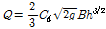
http://static.apub.kr/journalsite/sites/kwra/2016-049-12/N0200491201/images/PICC506.gif (1)

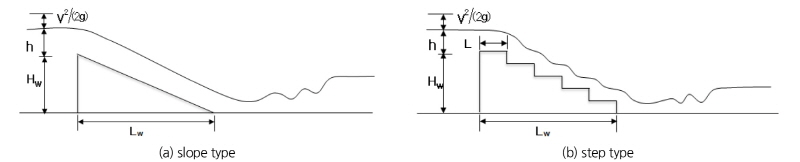
여기에서 http://static.apub.kr/journalsite/sites/kwra/2016-049-12/N0200491201/images/PICC5E2.gif는 유량(m3/s), http://static.apub.kr/journalsite/sites/kwra/2016-049-12/N0200491201/images/PICC5F2.gif는 유량계수, http://static.apub.kr/journalsite/sites/kwra/2016-049-12/N0200491201/images/PICC612.gif는 중력가속도(m/s2), http://static.apub.kr/journalsite/sites/kwra/2016-049-12/N0200491201/images/PICC633.gif는 수로 폭(m), http://static.apub.kr/journalsite/sites/kwra/2016-049-12/N0200491201/images/PICC653.gif는 상류 유효수심(상류수면고와 위어 끝의 차, m)을 나타낸다. 본 연구에서는 경사형 보와 계단형 보를 실험 대상으로 하였으며 이에 대한 기하학적 매개변수에서 http://static.apub.kr/journalsite/sites/kwra/2016-049-12/N0200491201/images/PICC683.gif는 보의 높이(m), http://static.apub.kr/journalsite/sites/kwra/2016-049-12/N0200491201/images/PICC6A3.gif은 crest의 길이(m), http://static.apub.kr/journalsite/sites/kwra/2016-049-12/N0200491201/images/PICC6C3.gif는 잠긴 흐름 하류 유효수심(m)이다. 자유 흐름의 유량을 종속변수로 하여 다음과 같이 나타낼 수 있다(Kabiri-Samani and Javaheri, 2012).

http://static.apub.kr/journalsite/sites/kwra/2016-049-12/N0200491201/images/PICC712.gif                (2)

여기서, http://static.apub.kr/journalsite/sites/kwra/2016-049-12/N0200491201/images/PICC733.gif는 함수기호이며, http://static.apub.kr/journalsite/sites/kwra/2016-049-12/N0200491201/images/PICC791.gif는 표면장력(N/m), http://static.apub.kr/journalsite/sites/kwra/2016-049-12/N0200491201/images/PICC7B2.gif는 밀도(kg/m3), http://static.apub.kr/journalsite/sites/kwra/2016-049-12/N0200491201/images/PICC7D2.gif는 동점성계수(m2/s)이다. Eq. (2)를 유량계수에 영향을 미치는 인자에 대해 정리하면 Eq. (3)이 된다.
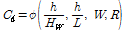
http://static.apub.kr/journalsite/sites/kwra/2016-049-12/N0200491201/images/PICC802.gif (3)

여기서, http://static.apub.kr/journalsite/sites/kwra/2016-049-12/N0200491201/images/PICC822.gif는 Weber number이며 http://static.apub.kr/journalsite/sites/kwra/2016-049-12/N0200491201/images/PICC8A0.gifhttp://static.apub.kr/journalsite/sites/kwra/2016-049-12/N0200491201/images/PICC8E0.gif으로 계산될 수 있으며, 실험에서 http://static.apub.kr/journalsite/sites/kwra/2016-049-12/N0200491201/images/PICC90F.gif일 경우 표면장력의 유량에 미치는 영향이 매우 작으므로 http://static.apub.kr/journalsite/sites/kwra/2016-049-12/N0200491201/images/PICC930.gif를 무시할 수 있다( Novak and Cabelka, 1981). 또한 http://static.apub.kr/journalsite/sites/kwra/2016-049-12/N0200491201/images/PICC940.gif는 Reynolds number이며 http://static.apub.kr/journalsite/sites/kwra/2016-049-12/N0200491201/images/PICC9BE.gif이다. Henderson (1966)에 의하면 난류 흐름에서 점성의 영향이 중력의 영향보다 작기 때문에 http://static.apub.kr/journalsite/sites/kwra/2016-049-12/N0200491201/images/PICC9DF.gif을 제외하면 아래와 같이 정리할 수 있다.

http://static.apub.kr/journalsite/sites/kwra/2016-049-12/N0200491201/images/PICCA0E.gif (4)

만약 하류수위가 보의 특정 수위를 넘어서면 유량에 영향을 미쳐 상류쪽 수위가 증가하는 현상이 발생한다. Villemonte (1947), Falvey (2002), Borghei et al. (2003), Tullis et al. (2007)의 연구에 의하면 잠긴 흐름에서 유량감소계수 http://static.apub.kr/journalsite/sites/kwra/2016-049-12/N0200491201/images/PICCA2F.gif는 잠긴 흐름에서의 유량과 자유 흐름에서의 유량 비로써 http://static.apub.kr/journalsite/sites/kwra/2016-049-12/N0200491201/images/PICCA5F.gif와 관계 그래프를 그릴 수 있다. 잠긴 흐름에 대한 식은 아래와 같다.

http://static.apub.kr/journalsite/sites/kwra/2016-049-12/N0200491201/images/PICCA7F.gif (5)

http://static.apub.kr/journalsite/sites/kwra/2016-049-12/N0200491201/images/PICCA9F.gifhttp://static.apub.kr/journalsite/sites/kwra/2016-049-12/N0200491201/images/PICCAB0.gif은 잠긴 흐름 및 자유 흐름 시 유량을 나타내며 http://static.apub.kr/journalsite/sites/kwra/2016-049-12/N0200491201/images/PICCAD0.gifhttp://static.apub.kr/journalsite/sites/kwra/2016-049-12/N0200491201/images/PICCAF0.gif는 잠긴 흐름 시 상·하류 유효수심을 나타낸다. Fig. 1은 잠긴 흐름 시 Villemonte (1947)의 모식도를 나타낸다.

http://static.apub.kr/journalsite/sites/kwra/2016-049-12/N0200491201/images/Figure_KWRA_49_12_01_F1.jpg
Fig. 1

Illustration of submerged weir flow superposition assumption as described by Villemonte (1947)

3. 실험준비 및 방법

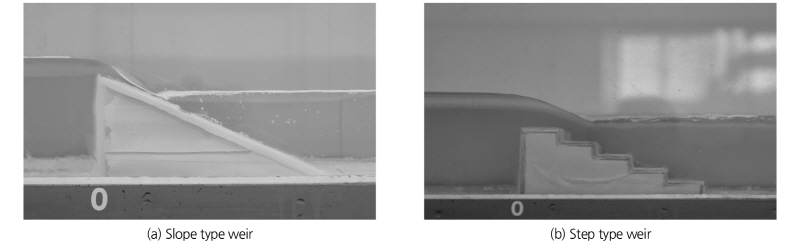
수리모형실험은 폭 0.4 m, 총 길이 10.0 m, 높이 0.5 m인 가변경사 사각형 수로에서 수행하였으며, 고수조를 통해 유량을 조절하였다(Fig. 2). 수로 바닥은 철제이며 좌우 측벽은 강화 유리로 제작되어 실험 중 수면 형상이나 공기방울의 거동 등을 육안으로 관찰하기에 용이하도록 하였다. 실험 모형인 경사형 및 계단형 보와 crest는 3D 프린터를 이용해 제작하였다(Fig. 3; Fig. 4; Fig. 5).
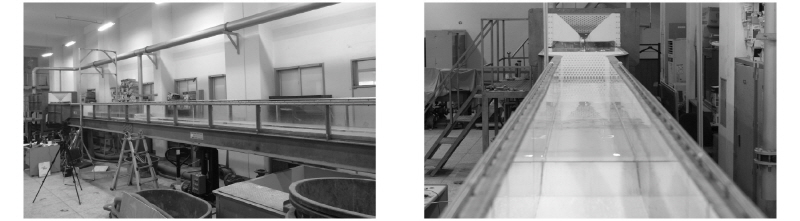
http://static.apub.kr/journalsite/sites/kwra/2016-049-12/N0200491201/images/Figure_KWRA_49_12_01_F2.jpg
Fig. 2

Experimental flume

http://static.apub.kr/journalsite/sites/kwra/2016-049-12/N0200491201/images/Figure_KWRA_49_12_01_F3.jpg
Fig. 3

Installation of weir model (case 1)

http://static.apub.kr/journalsite/sites/kwra/2016-049-12/N0200491201/images/Figure_KWRA_49_12_01_F4.jpg
Fig. 4

Case of slope type weir

http://static.apub.kr/journalsite/sites/kwra/2016-049-12/N0200491201/images/Figure_KWRA_49_12_01_F5.jpg
Fig. 5

Case of step type weir

본 연구에서는 crest 길이에 따라 자유 흐름 조건의 수위를 측정하고, 하류게이트를 이용해 잠긴 흐름을 발생 시킨 후 수위를 측정하는 방법으로 실험을 수행하였다. 예비실험을 통해 보 모형의 부착에 대한 안전성 및 유량별 월류수심을 확인한 후 본 실험을 수행하였다.

실험은 crest 길이(http://static.apub.kr/journalsite/sites/kwra/2016-049-12/N0200491201/images/PICCB20.gif)에 따라 총 4개의 case로 나누어 수행하였다. 각 case 별 총 8개 유량조건에 대해 각각 자유흐름과 잠긴 흐름에서의 수위를 측정하였으며 정확한 흐름 및 수위 계측을 위해 디지털 카메라와 캠코더를 활용하였다. 실험 case 및 실험 조건은 Table 1과 같다.
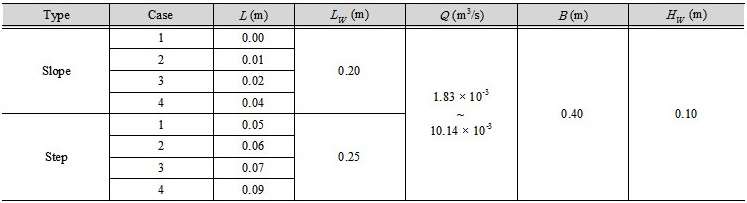
Table 1. Experimental cases

http://static.apub.kr/journalsite/sites/kwra/2016-049-12/N0200491201/images/Table_KWRA_49_12_01_T1.jpg

4. 실험결과

4.1 자유흐름 조건

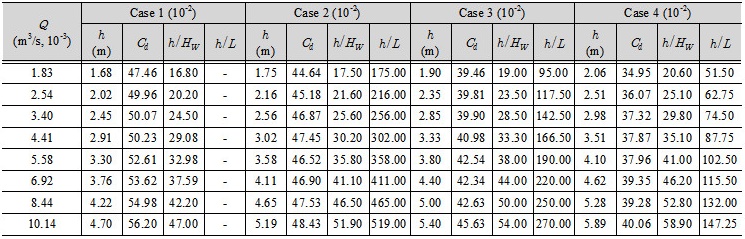
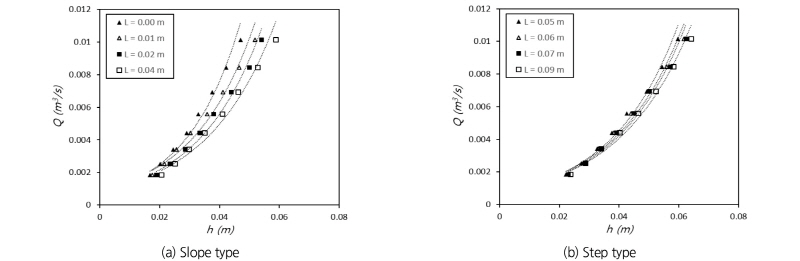
자유 흐름 조건에서 각 case 별 수위-유량 관계 분석 및 유량계수를 산정하였다(Tables 2 and 3). Fig. 6은 자유흐름조건을 나타내며 Fig. 7은 경사형 보와 계단형 보의 수위-유량 관계그래프이다. 그래프 분석결과 같은 유량조건에서는 crest가 증가할수록 수위(http://static.apub.kr/journalsite/sites/kwra/2016-049-12/N0200491201/images/PICCB40.gif)도 증가하였으며 유량별 수위 범위는 경사형 보가 계단형 보 보다 넓게 나타났다. 또한 보 형태와 관계없이 유량이 증가할수록 수위(http://static.apub.kr/journalsite/sites/kwra/2016-049-12/N0200491201/images/PICCB61.gif)의 범위도 증가 하였다.

Table 2. Experimental result on free flow condition (slope type)

http://static.apub.kr/journalsite/sites/kwra/2016-049-12/N0200491201/images/Table_KWRA_49_12_01_T2.jpg

Table 3. Experimental result on free flow condition (step type)

http://static.apub.kr/journalsite/sites/kwra/2016-049-12/N0200491201/images/Table_KWRA_49_12_01_T3.jpg

http://static.apub.kr/journalsite/sites/kwra/2016-049-12/N0200491201/images/Figure_KWRA_49_12_01_F6.jpg
Fig. 6

Free flow parameters for weir type

http://static.apub.kr/journalsite/sites/kwra/2016-049-12/N0200491201/images/Figure_KWRA_49_12_01_F7.jpg
Fig. 7

http://static.apub.kr/journalsite/sites/kwra/2016-049-12/N0200491201/images/PICCB81.gif rating curves for various crest length

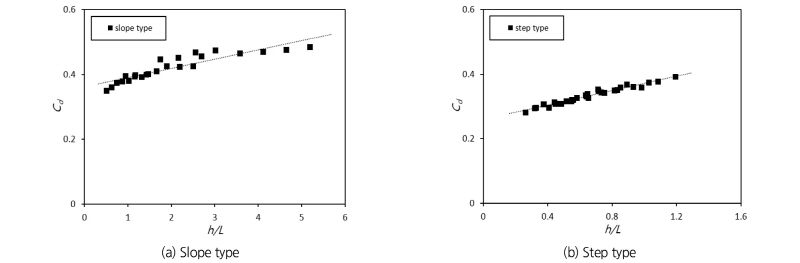
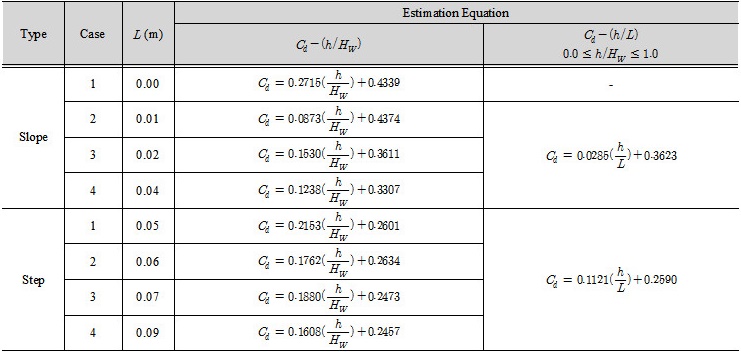
자유 흐름 조건에서의 유량계수(http://static.apub.kr/journalsite/sites/kwra/2016-049-12/N0200491201/images/PICCBA1.gif)는 식 (1)을 이용하여 산정하였다. Fig. 8은 경사형 보와 계단형 보의 http://static.apub.kr/journalsite/sites/kwra/2016-049-12/N0200491201/images/PICCBF0.gif 관계 그래프이다. 분석결과 http://static.apub.kr/journalsite/sites/kwra/2016-049-12/N0200491201/images/PICCC10.gif의 범위는 경사형과 계단형에서 각각 34.95 × 10⁻² ~ 56.20 × 10⁻², 28.14 × 10⁻² ~ 39.25 × 10⁻²이며 http://static.apub.kr/journalsite/sites/kwra/2016-049-12/N0200491201/images/PICCC21.gifhttp://static.apub.kr/journalsite/sites/kwra/2016-049-12/N0200491201/images/PICCC70.gif 관계는 비례하는 것으로 나타났다. Crest 변화에 대한 분석결과 crest가 증가할수록 http://static.apub.kr/journalsite/sites/kwra/2016-049-12/N0200491201/images/PICCCB0.gif 대비 http://static.apub.kr/journalsite/sites/kwra/2016-049-12/N0200491201/images/PICCCD0.gif는 감소하는 경향을 보였다. 또한 계단형 보에 비해 경사형 보의 유량계수가 크고 넓은 범위로 나타났다. Fig. 9는 보 형태별 모든 case에 대한 http://static.apub.kr/journalsite/sites/kwra/2016-049-12/N0200491201/images/PICCCE1.gifhttp://static.apub.kr/journalsite/sites/kwra/2016-049-12/N0200491201/images/PICCD10.gif의 관계 그래프를 나타내는 그림이다. 경사형 보의 case 1은 crest 길이(http://static.apub.kr/journalsite/sites/kwra/2016-049-12/N0200491201/images/PICCD31.gif)가 0 이므로 표시하지 않았다. 분석결과 http://static.apub.kr/journalsite/sites/kwra/2016-049-12/N0200491201/images/PICCD61.gif의 증가는 http://static.apub.kr/journalsite/sites/kwra/2016-049-12/N0200491201/images/PICCD71.gif에 크게 영향을 주지 않는 것으로 나타났다. 경사형 보에서 http://static.apub.kr/journalsite/sites/kwra/2016-049-12/N0200491201/images/PICCDA1.gif값의 범위는 51.50 × 10⁻² ~ 519.00 × 10⁻²이며 계단형 보에서 http://static.apub.kr/journalsite/sites/kwra/2016-049-12/N0200491201/images/PICCDD1.gif값의 범위는 26.44 × 10⁻² ~ 119.40 × 10⁻²으로 나타났다. 그래프 분석결과로 도출된 실험식은 아래의 Table 4에 정리하였다.
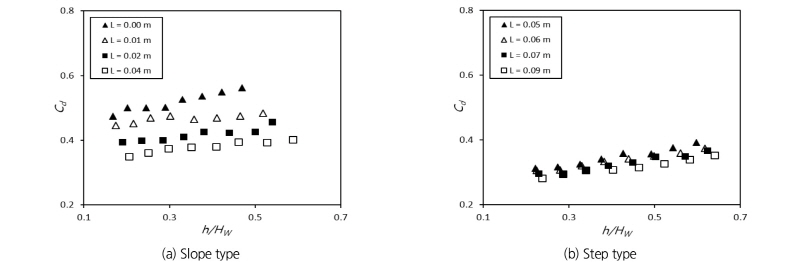
http://static.apub.kr/journalsite/sites/kwra/2016-049-12/N0200491201/images/Figure_KWRA_49_12_01_F8.jpg
Fig. 8

Variation of free overflow discharge coefficient versus http://static.apub.kr/journalsite/sites/kwra/2016-049-12/N0200491201/images/PICCE20.gif for various crest length

http://static.apub.kr/journalsite/sites/kwra/2016-049-12/N0200491201/images/Figure_KWRA_49_12_01_F9.jpg
Fig. 9

Variation of free overflow discharge coefficient versus http://static.apub.kr/journalsite/sites/kwra/2016-049-12/N0200491201/images/PICCE50.gif for weir type

Table 4. Experimental equations for free flow condition

http://static.apub.kr/journalsite/sites/kwra/2016-049-12/N0200491201/images/Table_KWRA_49_12_01_T4.jpg

4.2 잠긴흐름 조건

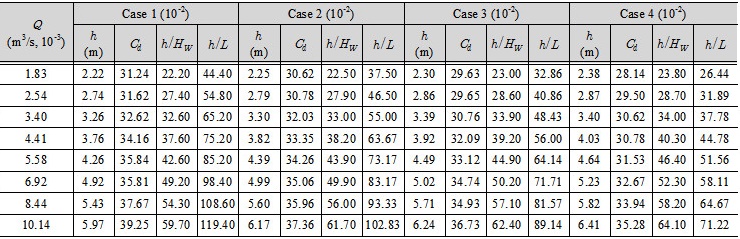
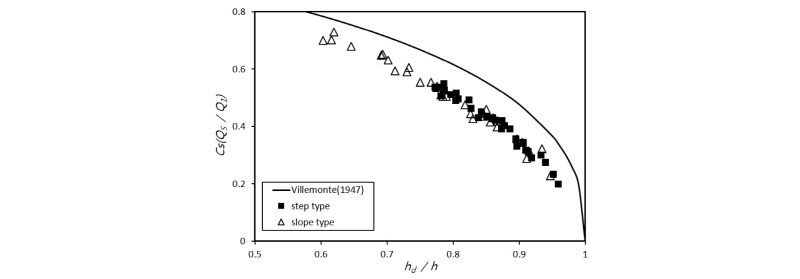
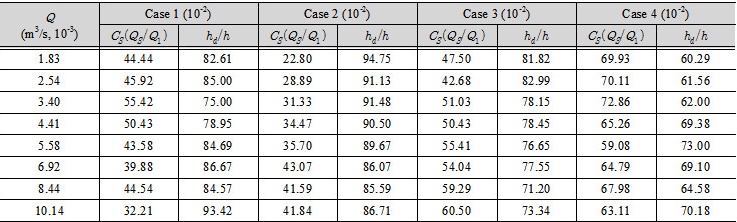
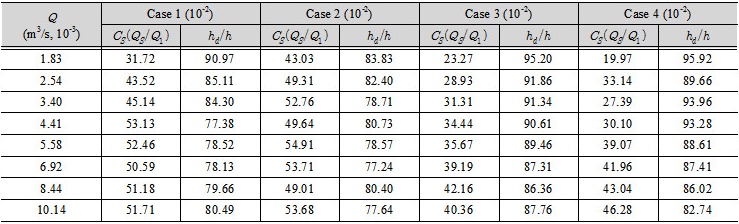
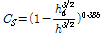
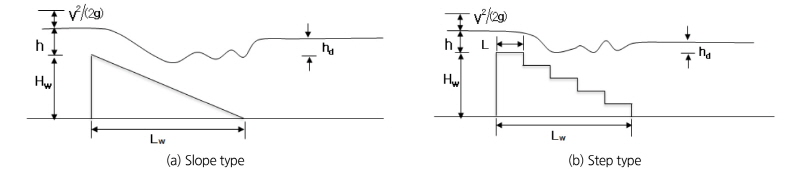
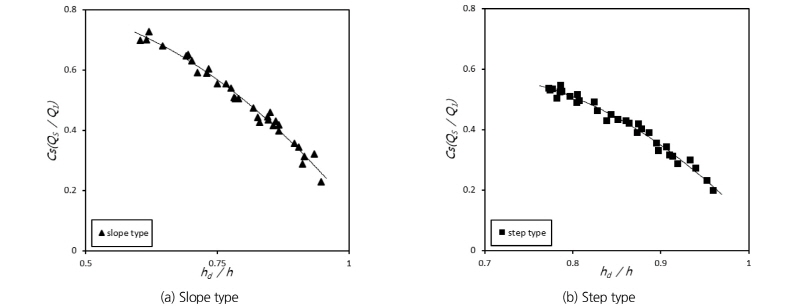
보의 형태 및 crest 길이에 따른 잠긴 흐름의 수위를 측정하여 자유 흐름 유량과 잠긴 흐름 유량 비교값인 유량감소계수http://static.apub.kr/journalsite/sites/kwra/2016-049-12/N0200491201/images/PICCF4B.gif와 잠긴 흐름조건의 상·하류 수심비http://static.apub.kr/journalsite/sites/kwra/2016-049-12/N0200491201/images/PICCF8A.gif의 관계를 분석하였다(Tables 5 and 6). 아래의 Fig. 10은 잠긴흐름 조건을 나타내며 Fig. 11은 경사형 및 계단형 보의 http://static.apub.kr/journalsite/sites/kwra/2016-049-12/N0200491201/images/PICCFAB.gifhttp://static.apub.kr/journalsite/sites/kwra/2016-049-12/N0200491201/images/PICCFCB.gif의 관계를 나타내는 그래프이다. 분석결과 http://static.apub.kr/journalsite/sites/kwra/2016-049-12/N0200491201/images/PICCFFB.gif가 증가할수록 http://static.apub.kr/journalsite/sites/kwra/2016-049-12/N0200491201/images/PICD01B.gif는 감소하며, http://static.apub.kr/journalsite/sites/kwra/2016-049-12/N0200491201/images/PICD04B.gif가 경사형에서는 60.29 × 10⁻² 이상, 계단형에서는 77.24 × 10⁻² 이상 시에 잠긴 흐름이 발생하였다. 유량감소계수http://static.apub.kr/journalsite/sites/kwra/2016-049-12/N0200491201/images/PICD06B.gif의 범위는 경사형 보와 계단형 보에서 각각 22.80 × 10⁻² ~ 72.86 × 10⁻², 19.97 × 10⁻² ~ 54.91 × 10⁻²로 나타났다. 아래의 식은 그래프 분석 결과인 유량감소계수 산정식에 대해 정리하였다. 경사형 보는 Eq. (6)에 나타냈으며 http://static.apub.kr/journalsite/sites/kwra/2016-049-12/N0200491201/images/PICD09B.gif의 범위는 60.29 × 10⁻² http://static.apub.kr/journalsite/sites/kwra/2016-049-12/N0200491201/images/PICD0CB.gif ≤ 94.75 × 10⁻²이다. 또한 계단형 보는 Eq. (7)에 나타냈으며 http://static.apub.kr/journalsite/sites/kwra/2016-049-12/N0200491201/images/PICD0EB.gif 범위는 77.24 × 10⁻² http://static.apub.kr/journalsite/sites/kwra/2016-049-12/N0200491201/images/PICD11B.gif ≤ 95.92 × 10⁻²이다. Fig. 12는 잠긴 흐름 상태에서의 실험결과와 Villemonte, 1947의 제안식을 비교한 그래프이다. 비교결과 경사형 보와 계단형 보는 전반적으로 비슷한 유형을 보였으나 예연위어를 대상으로 한 기존 제안식과 비교 시 유량감소계수http://static.apub.kr/journalsite/sites/kwra/2016-049-12/N0200491201/images/PICD13B.gif는 평균 0.11(최대 0.17, 최소 0.04) 차이가 있는 것으로 나타났다. Eq. (8)은 Villemonte, 1947의 제안식이며 Eq. (9)는 본 연구에서 수행한 경사형 보와 계단형 보 전체에 대한 잠긴 흐름상태 산정식을 나타낸다.
http://static.apub.kr/journalsite/sites/kwra/2016-049-12/N0200491201/images/Figure_KWRA_49_12_01_F10.jpg
Fig. 10

Submerged flow parameters for weir type

http://static.apub.kr/journalsite/sites/kwra/2016-049-12/N0200491201/images/Figure_KWRA_49_12_01_F11.jpg
Fig. 11

Variation of submerged overflow discharge coefficient http://static.apub.kr/journalsite/sites/kwra/2016-049-12/N0200491201/images/PICD15C.gif versus http://static.apub.kr/journalsite/sites/kwra/2016-049-12/N0200491201/images/PICD18B.gif for weir type

http://static.apub.kr/journalsite/sites/kwra/2016-049-12/N0200491201/images/Figure_KWRA_49_12_01_F12.jpg
Fig. 12

Comparison of experimental submerged weir data to Villemonte, 1947

Table 5. Experimental result on submerged flow condition (slope type)

http://static.apub.kr/journalsite/sites/kwra/2016-049-12/N0200491201/images/Table_KWRA_49_12_01_T5.jpg

Table 6. Experimental result on submerged flow condition (step type)

http://static.apub.kr/journalsite/sites/kwra/2016-049-12/N0200491201/images/Table_KWRA_49_12_01_T6.jpg

http://static.apub.kr/journalsite/sites/kwra/2016-049-12/N0200491201/images/PICD1CB.gif

http://static.apub.kr/journalsite/sites/kwra/2016-049-12/N0200491201/images/PICD22A.gif (6)

http://static.apub.kr/journalsite/sites/kwra/2016-049-12/N0200491201/images/PICD25A.gif

http://static.apub.kr/journalsite/sites/kwra/2016-049-12/N0200491201/images/PICD2B8.gif (7)

http://static.apub.kr/journalsite/sites/kwra/2016-049-12/N0200491201/images/PICD307.gif (8)

http://static.apub.kr/journalsite/sites/kwra/2016-049-12/N0200491201/images/PICD3E3.gif

http://static.apub.kr/journalsite/sites/kwra/2016-049-12/N0200491201/images/PICD432.gif (9)

5. 결 론

본 연구에서는 실내실험을 통해 경사형 및 계단형 보의 crest 변화에 따른 유량계수http://static.apub.kr/journalsite/sites/kwra/2016-049-12/N0200491201/images/PICD472.gif를 도출하였으며 자유 흐름 및 잠긴 흐름 조건의 흐름특성을 분석하였다. 실험은 각 보의 형태별 crest 길이에 따라 총 4개의 case로 나누어 수행하였다. 실험 결과 자유 흐름 조건에서 crest가 증가할수록 http://static.apub.kr/journalsite/sites/kwra/2016-049-12/N0200491201/images/PICD4A2.gif 대비 http://static.apub.kr/journalsite/sites/kwra/2016-049-12/N0200491201/images/PICD4C2.gif는 감소하는 경향을 보였다. 또한 계단형 보에 비해 경사형 보의 http://static.apub.kr/journalsite/sites/kwra/2016-049-12/N0200491201/images/PICD4E2.gif가 크고 넓은 범위로 나타났으며 경사형 보는 crest 길이에 따라 http://static.apub.kr/journalsite/sites/kwra/2016-049-12/N0200491201/images/PICD4F3.gif의 변화가 계단형 보 보다 큰 것으로 나타났다. 잠긴 흐름에서는 상·하류 수심비http://static.apub.kr/journalsite/sites/kwra/2016-049-12/N0200491201/images/PICD542.gif인 가 증가할수록 유량감소계수http://static.apub.kr/journalsite/sites/kwra/2016-049-12/N0200491201/images/PICD572.gif는 감소하는 것으로 나타났다. 또한 잠긴흐름 발생시의 http://static.apub.kr/journalsite/sites/kwra/2016-049-12/N0200491201/images/PICD592.gifhttp://static.apub.kr/journalsite/sites/kwra/2016-049-12/N0200491201/images/PICD5C2.gif그래프를 확인한 결과, 경사형은 http://static.apub.kr/journalsite/sites/kwra/2016-049-12/N0200491201/images/PICD5E2.gif가 60.29 × 10⁻² 이상, 계단형은 77.24 × 10⁻² 이상 시 잠긴 흐름이 발생하는 것으로 나타났다. http://static.apub.kr/journalsite/sites/kwra/2016-049-12/N0200491201/images/PICD612.gif의 경우 경사형 보는 60.29 × 10⁻² http://static.apub.kr/journalsite/sites/kwra/2016-049-12/N0200491201/images/PICD642.gif ≤ 94.75 × 10⁻²이며 계단형 보는 77.24 × 10⁻² http://static.apub.kr/journalsite/sites/kwra/2016-049-12/N0200491201/images/PICD662.gif ≤ 95.92 × 10⁻²으로 나타났다. 향후 본 연구 결과는 중소하천 내 보를 월류하는 흐름구조에서 유량 측정을 위한 기초 자료가 될 것으로 판단되며 추가적으로 계단 형태 및 계단 수에 따른 흐름패턴 연구가 필요할 것으로 판단된다.


Acknowledgements

본 논문은 국토교통부 물관리연구사업의 연구비지원(12기술혁신 C02)에 의해 수행되었습니다.

References

1
Borghei, S. M., Jalili, M. R., and Ghodsian, M. (1999). “Discharge coefficient for shape-crested side weir in subcritical flow.” Journal of Hydraulic Engineering, ASCE, Vol. 125, No. 10, pp. 1051-1056.
2
Borghei, S. M., Vatannia, Z., Ghodsian, M., and Jalili, M. R. (2003). “Oblique rectangular sharp-crested weir.” Water and Maritime Engineering, Vol. 156, No. 2, pp. 185-191.
3
Bormann, N. E. and Julien, P. Y. (1991). “Scour downstream of grade- control structures.” Journal of Hydraulic Engineering, ASCE, Vol. 117, No. 5, pp. 579-594.
4
Chanson, H. (2001). “Teaching hydraulic design in an Australian undergraduate civil engineering curriculum.” Journal of Hydraulic Engineering, ASCE, Vol. 127, No. 12, pp. 1002-1008.
5
Falvey, H. T. (2002). Hydraulic design of labyrinth weirs. ASCE, Reston, Virginia, pp. 31-68.
6
Henderson, F. M. (1966). Open Channel Flow. The Macmillan Company, New York, pp. 48-85.
7
Hossein, A. and Sara, B. (2010). “Discharge coefficient of sharp-crested weirs using potential flow.” Journal of hydraulic Research, Vol. 47, No. 6, pp. 820-823.
8
Jin, S. W. (2007). Experimental study on discharge coefficient of diagonal weirs. M.S. dissertation, University of Hongik, Korea, pp. 19-60.
9
Kabiri-Samani, A. R. and Javaheri, A. (2012). “Discharge coefficient for free and submerged flow over piano key weirs.” Journal of hydraulic Research, Vol. 50, No. 1, pp. 114-120.
10
Kang, J. G., Yeo, H. K., Lee, K. C., and Choi, N. J. (2010). “Experimental study on flow characteristic and wave type flow at downstream of stepped weir.” Journal of Korea Water Resources Association, Vol. 43, No. 1, pp. 41-49.
11
Kim, H. J., Kim, C. W., and Woo, H. S. (2003). “The effect that stream of river-cross structure for ecological development its alternative.” Journal of Korean Society of Civil Engineers, KSCE, Vol. 51, No. 3, pp. 42-58.
12
Korea Water Resources Association (2005). River design standards and explanation. Journal of Korea Water Resources Association, pp. 411-420.
13
Novak, P. and Cabelka, J. (1981). Models in hydraulic engineering. Pitman, London, UK, pp. 185-187.
14
Ohtsu, I., Yasuda, Y., and Gotoh, H. (2001). “Hydraulic condition for undular-jump formations.” Journal of Hydraulic Research, Vol. 39, No. 2, pp. 203-209.
15
Rice, C. E., Kadavy, K. C., and Robinson, K. M. (1998). “Roughness of loose rock riprap on steep slopes.” Journal of Hydraulic Engineering, ASCE, Vol. 124, No. 2, pp. 179-185.
16
Song, J. W., Park, Y. J., and Lee, Y. H. (1994). “Characteristics of channel bend reach and shape of cross-section.” Journal of Korean Society of Civil Engineers, KSCE, Vol. 14, No. 5, pp. 1191-1197.
17
Tullis, B. P., Young, J. C., and Chandler, M. A. (2007). “Head-discharge relationships for submerged labyrinth weirs.” Journal of Hydraulic Engineering, Vol. 133, No. 3, pp. 248-254.
18
Villemonte, J. R. (1947). “Submerged weir discharge studies.” Engineering News-Record, Vol. 139, No. 26, pp. 54-57.
19
We, Y. M. (2005). Aeration & Energy dissipation efficiency by overflow of steped weir. Ph. D. dissertation, University of Chung-Ang, pp. 34-97.
20
Yeo, H. G., Kang, J. G., Cheong, S. H., and Yoon, B. M. (2005). “Experimental study on establishment of downstream critical depth in round-crested weir.” Proceedings Korea Water Resources Association, KWRA, pp. 1113-1117.
21
Zerihun, Y. T. and Fenton, J. D. (2007). “A Boussinesq-type model for flow over trapezoidal profile weirs.” Journal of Hydraulic Research, Vol. 45, No. 4, pp. 519-528.
페이지 상단으로 이동하기