

-
Review
-
Conceptualization and framework of spatial flood retention technology for urban flood management: Focusing on limitations of conventional systems
도시홍수 대응을 위한 공간저류기술의 개념 정립과 프레임워크: 기존 대응 체계의 한계 분석을 중심으로
-
Hoje Seong, Dong-Sop Rhee
성호제, 이동섭
- Urban flood management has traditionally relied on the centralized Collect–Transport–Discharge (CTD) paradigm, which rapidly collects, conveys, and discharges stormwater through drainage infrastructure. …
도시홍수 대응 체계는 우수관거, 유수지, 빗물펌프장 등 배수 인프라를 통해 강우 유출을 신속히 수집·이송·배제하는 집중형 배제(Collect–Transport–Discharge, CTD) 방식에 기반하여 발전해왔다. 그러나 기후변화에 …
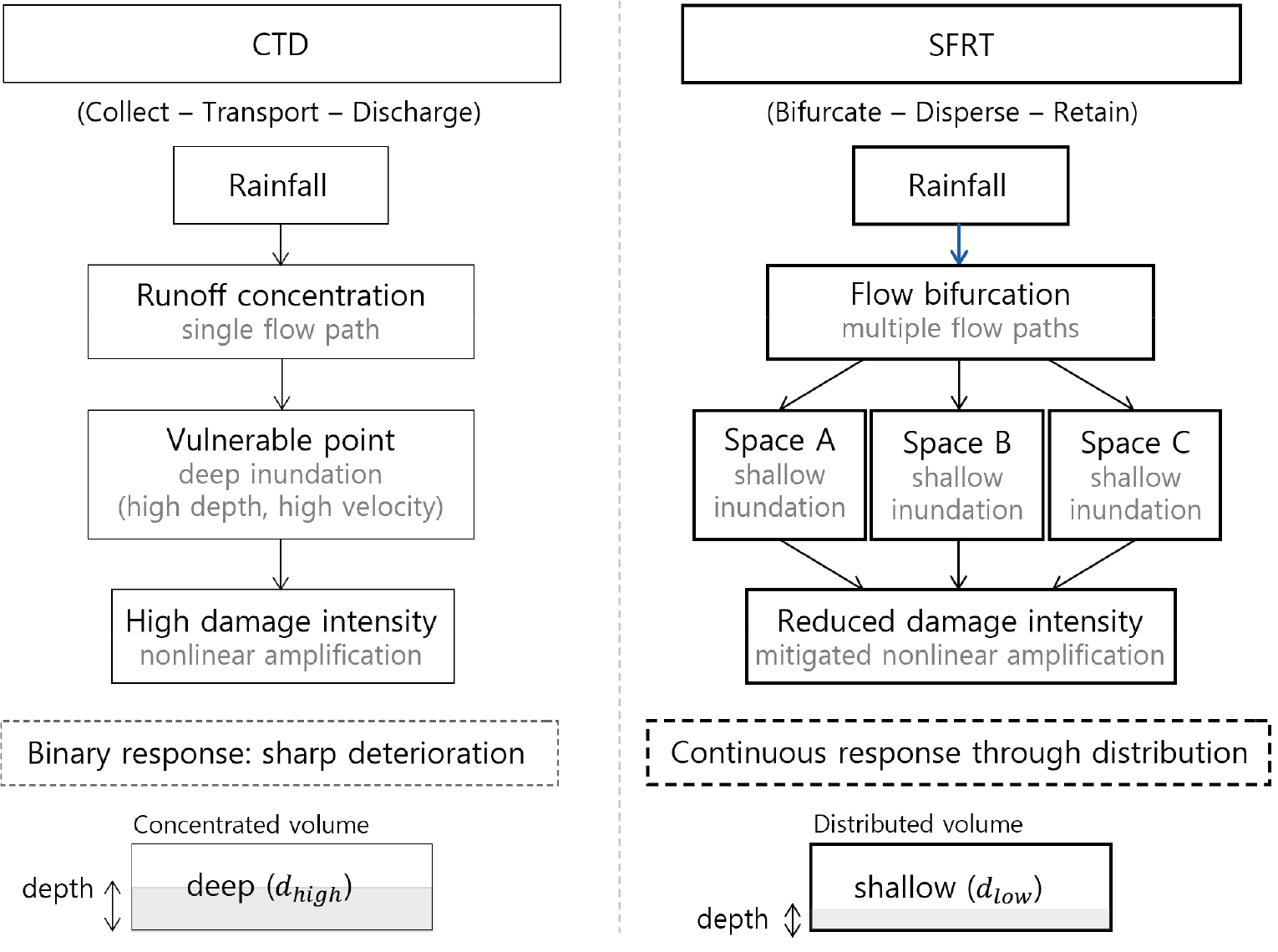
- Urban flood management has traditionally relied on the centralized Collect–Transport–Discharge (CTD) paradigm, which rapidly collects, conveys, and discharges stormwater through drainage infrastructure. However, climate-change-driven extreme rainfall and expanding impervious surfaces have exposed its structural limitations under design-exceedance conditions, as system performance rapidly degrades and runoff becomes concentrated at specific locations. This study reviews the types, research trends, and limitations of existing urban flood management technologies and reinterprets representative international cases, including Room for the River, Floodable Parks, and Water Squares, together with domestic urban retention and inundation mitigation cases, to establish the concept of Spatial Flood Retention Technology (SFRT). SFRT is defined as an approach that controls the spatial distribution of surface runoff and redistributes concentrated flow into designated flood-accommodating spaces, thereby reducing inundation depth and damage intensity. Based on runoff concentration mechanisms and nonlinear flood damage characteristics, this study proposes a conceptual framework that includes applicable urban space types, drainage linkage and recovery conditions, and design principles. SFRT complements conventional technologies by extending the control target from runoff volume and discharge capacity to runoff distribution. Further studies are required to verify the concept through numerical modeling, empirical analysis, safety criteria development, and drainage-system linkage assessment.
- COLLAPSE
도시홍수 대응 체계는 우수관거, 유수지, 빗물펌프장 등 배수 인프라를 통해 강우 유출을 신속히 수집·이송·배제하는 집중형 배제(Collect–Transport–Discharge, CTD) 방식에 기반하여 발전해왔다. 그러나 기후변화에 따른 극한 강우 증가와 불투수면 확대는 설계 기준을 초과하는 조건에서 기존 체계의 구조적 한계를 드러내고 있으며, 이때 배수 성능은 급격히 저하되고 유출은 특정 지점으로 집중되는 경향을 보인다. 본 연구는 기존 도시홍수 대응 기술의 유형, 연구동향 및 한계를 검토하고, Room for the River, Floodable Parks, Water Squares 등 국외 사례와 국내 도시 저류 및 침수 저감 사례를 재해석하여 공간저류기술(Spatial Flood Retention Technology, SFRT)의 개념을 정립하였다. SFRT는 지표유출의 공간적 분포를 제어하고 집중된 유출을 계획된 침수 허용 공간으로 재분배함으로써 침수심과 피해 강도를 저감하는 접근으로 정의된다. 또한 본 연구는 유출 집중 메커니즘과 침수 피해의 비선형 특성을 바탕으로 적용 가능한 도시 공간 유형, 배수체계 연계 및 기능 회복 조건, 설계 원칙을 포함하는 개념적 프레임워크를 제시하였다. SFRT는 기존 기술을 대체하는 것이 아니라, 유출량 및 배제 용량 중심의 대응을 유출 분포 제어로 확장함으로써 기존 기술을 보완하는 개념이다. 향후 수치모형, 실증 분석, 안전 기준 개발 및 배수체계 연계성 평가를 통해 제안 개념의 타당성을 검증할 필요가 있다.
-
Conceptualization and framework of spatial flood retention technology for urban flood management: Focusing on limitations of conventional systems
-
Review
-
A review of development of advanced remote sensing-based technology for available water resources monitoring: Status and future directions
첨단 원격탐사 기반 수자원 활용 가능량 모니터링 기술개발 동향 및 전망에 관한 고찰
-
Wanyub Kim, Seokhwan Hwang, Bokjin Jang, Jonghyuk Yi, Yong Hee Park, Minha Choi
김완엽, 황석환, 장복진, 이종혁, 박용희, 최민하
- As the frequency and intensity of droughts increase due to climate change, the importance of accurately quantifying available water resources and developing …
기후변화로 인한 가뭄 발생 빈도와 강도가 증가함에 따라 수자원 활용 가능량의 정밀한 파악과 실시간 모니터링 기술의 중요성이 높아지고 있다. 그러나 기존의 지점 …
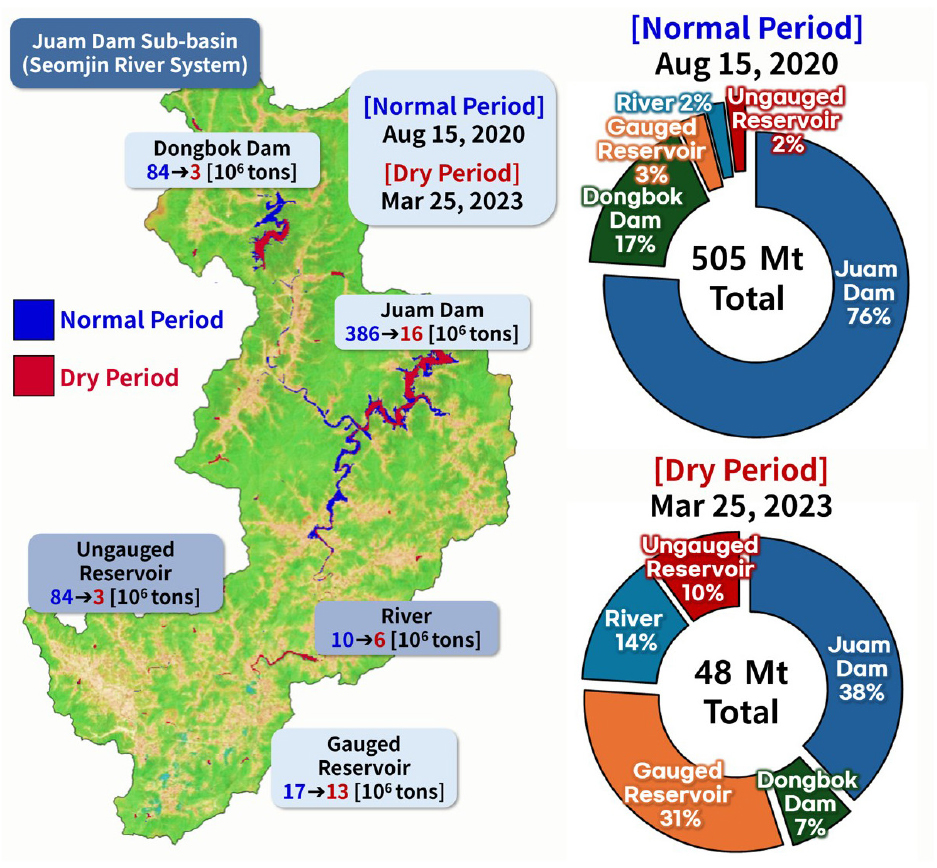
- As the frequency and intensity of droughts increase due to climate change, the importance of accurately quantifying available water resources and developing real-time monitoring technologies has been increasing. However, conventional site-based hydrologic monitoring systems have structural limitations in capturing the spatially and temporally heterogeneous distribution of water resources at a regional scale, and standardized methodologies for spatially continuous estimation of available water resources using remote sensing data have not yet been established. In this study, the current status and future direction of advanced remote sensing-based technologies for monitoring available water resources were systematically reviewed from the perspectives of bathymetric Digital Elevation Model (DEM) construction, surface water area, water level, water storage estimation, available water resources monitoring framework, and integrated monitoring system development. Bathymetric DEM construction technologies, surface water area estimation, water level estimation, and water storage estimation were comprehensively examined through the integration of multi-source remote sensing data, including acoustic echo sounding and airborne LiDAR, optical and Synthetic Aperture Radar (SAR) satellite imagery, and satellite altimetry and the Surface Water and Ocean Topography (SWOT) mission. Furthermore, this study proposed a direction for establishing an available water resources monitoring framework that integrates minimum maintenance flow, water quality conditions, groundwater, and precipitation data with physical water storage information. This study provides insights into how to overcome the limitations of conventional point-based water resources assessment systems and develop nationwide technologies for the spatio-temporal quantification and monitoring of available water resources.
- COLLAPSE
기후변화로 인한 가뭄 발생 빈도와 강도가 증가함에 따라 수자원 활용 가능량의 정밀한 파악과 실시간 모니터링 기술의 중요성이 높아지고 있다. 그러나 기존의 지점 기반 수문 관측 체계는 시·공간적으로 불균등하게 분포하는 수자원 현황을 광역적으로 파악하는 데 구조적 한계를 내포하고 있으며, 원격탐사 자료를 활용하여 공간적으로 연속적인 수자원 활용 가능량을 정량화하는 표준화된 방법론은 아직 정립되지 않은 실정이다. 본 연구에서는 첨단 원격탐사 자료를 활용한 수자원 활용 가능량 모니터링 기술의 현황과 발전 방향을 수자원 물그릇 DEM 구축, 수표면적 및 수위 산정, 수자원량 산정, 수자원 활용 가능량 모니터링 체계 구축, 통합 모니터링 시스템 개발의 관점에서 체계적으로 검토하였다. 음향측심 및 항공 라이다 기반 물그릇 DEM 구축 기술, 광학·SAR 위성영상 기반 수표면적 산정 기술, 위성 고도계 및 SWOT 기반 수위 산정 기술, 다종 원격탐사 자료 융합 기반 수자원량 산정 기술을 종합적으로 검토하였으며, 물리적 수자원량에 최소유지수량, 수질 조건, 지하수 및 강수량 자료를 통합적으로 반영하는 수자원 활용 가능량 모니터링 체계의 구축 방향을 제시하였다. 본 논문에서는 기존 지점 기반 수자원 평가 체계의 한계를 극복하고 전국 단위 수자원 활용 가능량의 시·공간적 정량화 및 모니터링 기술 개발 방안의 방향성을 제시하였다.
-
A review of development of advanced remote sensing-based technology for available water resources monitoring: Status and future directions
-
Research Article
-
A stepwise pre- and post-processing framework for quality control of real-time velocity time series
실시간 유속 시계열의 품질개선을 위한 단계적 전처리-후처리 프레임워크
-
Chanwoo Kim, Sanguk Cho, Youngyong Ryu, Dongheon Oh, Jaehyun Song
김찬우, 조상욱, 류영용, 오동헌, 송재현
- Real-time river velocity records are increasingly used in flood monitoring, discharge estimation, and hydrological decision-making. Their reliability, however, is often limited by …
실시간 유속 시계열은 홍수 모니터링, 유량 산정, 수문 의사결정 등 다양한 분야에서 활발히 활용되고 있다. 그러나 원시 관측자료에는 센서 노이즈와 스파이크형 이상치, …
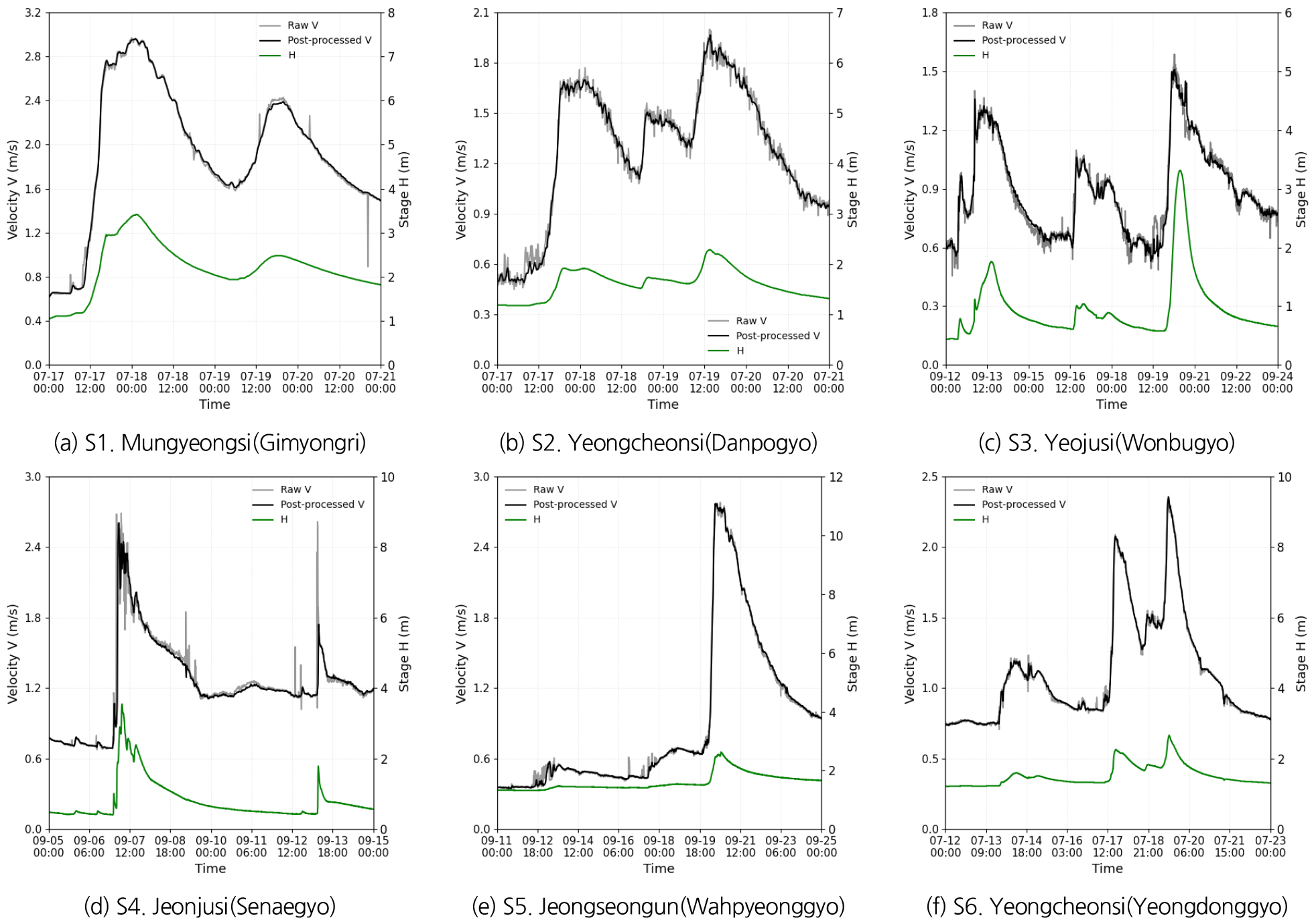
- Real-time river velocity records are increasingly used in flood monitoring, discharge estimation, and hydrological decision-making. Their reliability, however, is often limited by sensor noise, spike anomalies, and high-frequency fluctuations. This study presents a stepwise pre- and post-processing framework for improving the quality of real-time velocity time series. Six monitoring sites were selected from hydrological events observed during the 2025 flood season to represent different error characteristics. In preprocessing, a Huber-weighted recursive least squares model estimated a reference velocity from the stage-velocity relationship, followed by fuzzy rule-based and trailing-window Hampel filters to correct abrupt anomalies and local fluctuations under real-time constraints. In postprocessing, a centered-window Hampel filter refined residual outliers, and zero-phase moving average smoothing was applied using an optimal window size selected based on velocity-increment variance ratio, peak velocity retention, slope retention, and velocity-sum ratio. The fuzzy filter reduced the variance of velocity increments by 29.9~70.5%. The trailing- and centered-window Hampel filters further reduced variability by 2.0~15.7% and 2.3~8.5%, respectively. After zero-phase smoothing, the peak velocity retention ratio was 0.988~0.999, and the velocity-sum ratio remained 1.0 at all sites. The processed time series showed more consistent velocity responses to water-level changes than the raw data, indicating improved stability and interpretability while preserving hydrological shape.
- COLLAPSE
실시간 유속 시계열은 홍수 모니터링, 유량 산정, 수문 의사결정 등 다양한 분야에서 활발히 활용되고 있다. 그러나 원시 관측자료에는 센서 노이즈와 스파이크형 이상치, 고주파 변동이 복합적으로 포함되어 실시간 활용에 필요한 안정적인 품질을 확보하기 어렵다. 이에 본 연구는 실시간 유속 시계열의 품질을 개선하기 위한 전처리-후처리 프레임워크를 제시하였다. 대상 자료는 2025년 홍수기 중 수문사상이 발생한 관측 지점 가운데 서로 다른 오류 특성이 관측된 6개 지점의 유속 시계열로 선정하였다. 실시간 전처리 단계는 Huber 가중 재귀적 최소자승법 기반의 온라인 갱신이 가능한 학습모델로 수위-유속 관계를 반영한 참조유속을 생성하고, 퍼지 규칙 필터와 후행창 Hampel 필터를 적용하여 급격한 이상치와 국지 변동을 보정하도록 구현하였다. 비실시간 후처리 단계는 중앙창 Hampel 필터로 잔류 이상치를 정제하고, 인접 유속 변화량 분산 비율과 첨두유속 보존율, 기울기 보존율, 유속 합계 비율을 고려한 최적 창 크기 기반의 0-위상 이동평균으로 최종 평활화를 수행하도록 구성하였다. 퍼지 필터 단계에서 유속 변화량의 분산은 지점별로 29.9~70.5% 감소되었고, 후행창 및 중앙창 Hampel 필터 단계에서 시계열 변동성은 각각 2.0~15.7%와 2.3~8.5% 추가 완화되었다. 또한 0-위상 이동평균 단계에서는 모든 지점에서 첨두유속 보존율과 유속 합계 비율이 각각 0.988~0.999의 범위와 1.0으로 유지되었다. 최종 처리된 시계열은 수위 변화에 대한 유속 반응이 원시자료보다 일관된 형태로 정리되었으며, 이는 제안된 프레임워크가 자료의 수문학적 형태를 보존하면서 안정성과 해석성을 높일 수 있음을 보여준다.
-
A stepwise pre- and post-processing framework for quality control of real-time velocity time series
-
Research Article
-
Experimental analysis of vertical seawater intrusion and freshwater recovery in a coastal aquifer behind a seawall under seawater flooding
해수범람에 따른 호안 배후 해안대수층의 수직 해수침투 및 담수 회복에 관한 실험적 분석
-
Sung Cho, Taegeon Hwang, Seungjun Shin, Yeonjoong Kim, Woo-Dong Lee
조성, 황태건, 신승준, 김연중, 이우동
- Rising sea levels and extreme coastal hazards increase the likelihood of seawater flooding, thereby exacerbating the risk of seawater intrusion into coastal …
해수면 상승과 극한 연안재해는 해수범람의 발생 가능성을 증가시키며 이에 따라 해안대수층의 해수 침투 위험을 가중시킨다. 본 연구는 해수범람 조건에서 불투과성 호안 배후 …
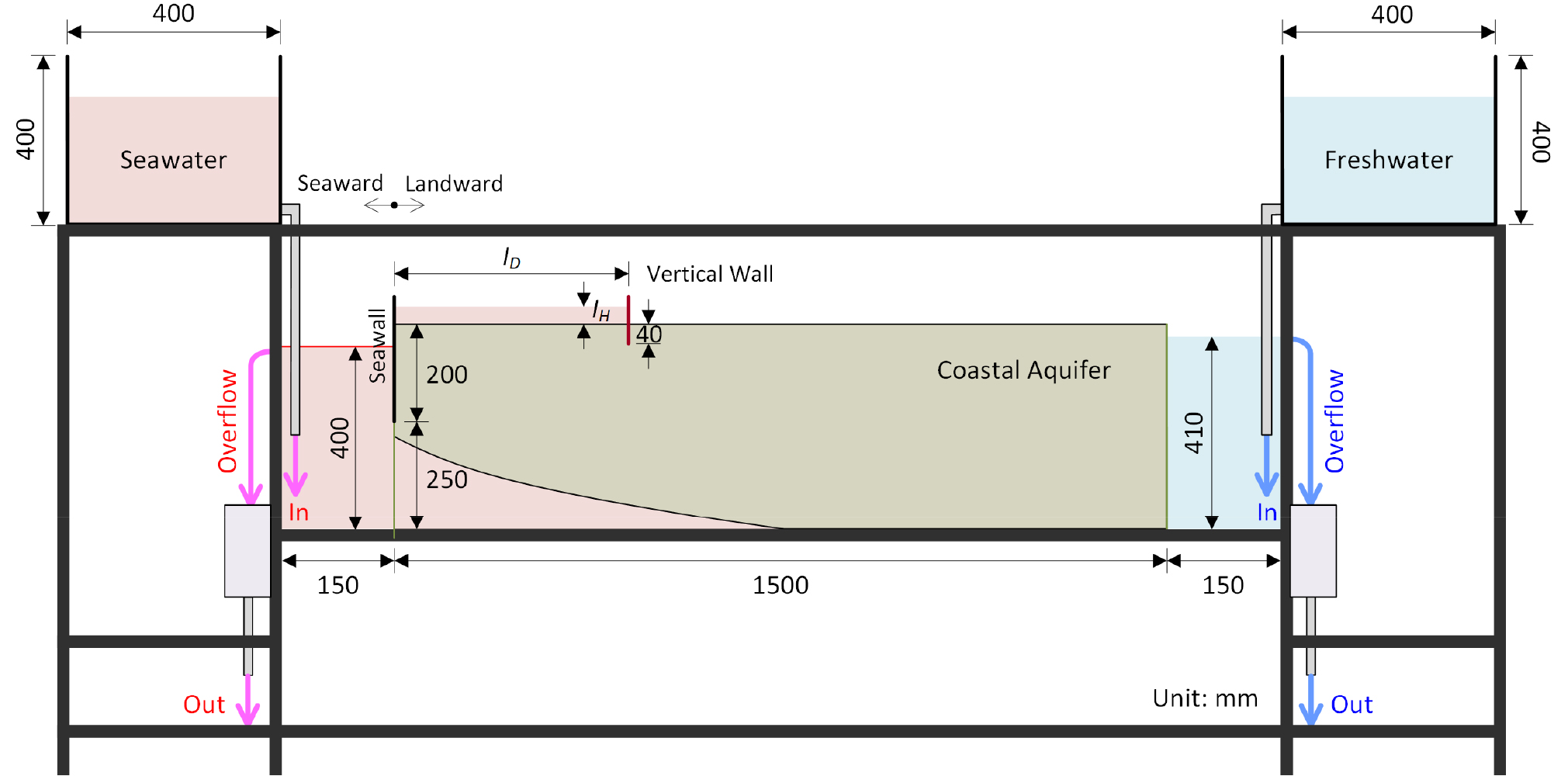
- Rising sea levels and extreme coastal hazards increase the likelihood of seawater flooding, thereby exacerbating the risk of seawater intrusion into coastal aquifers. This study experimentally investigated the vertical seawater intrusion and freshwater recovery processes occurring in a coastal aquifer behind an impermeable seawall under seawater flooding conditions. To this end, sand tank experiments were conducted under varying inundation heights and inundation distances. In addition, a computer vision-based image analysis method was applied to track the spatiotemporal evolution of the seawater region and to quantify its expansion and recovery characteristics. The results showed that seawater introduced from the land surface propagated downward and interacted with the pre-existing seawater region. As inundation height increased, the spatial extent of the seawater region changed, whereas the maximum seawater-region area exhibited a nonlinear response. In contrast, as the inundation distance increased, both the amount of seawater entering the aquifer and the spatial extent of the seawater region increased markedly, resulting in a substantial increase in the time required to reach the recovery criterion. Furthermore, the time required to reach the recovery criterion was more sensitive to inundation distance than to inundation height, indicating that inundation distance is a key factor governing the persistence and recovery of the seawater region in coastal aquifers.
- COLLAPSE
해수면 상승과 극한 연안재해는 해수범람의 발생 가능성을 증가시키며 이에 따라 해안대수층의 해수 침투 위험을 가중시킨다. 본 연구는 해수범람 조건에서 불투과성 호안 배후 해안대수층에서 발생하는 수직적 해수침투 및 담수 회복 과정을 실험적으로 분석하였다. 이를 위해 침수높이와 침수거리를 달리한 모래수조 실험을 수행하였다. 또한 컴퓨터 비전 기반 영상분석 기법을 적용하여 해수영역의 시공간적 변화를 추적하고, 그 확장 및 회복 특성을 정량화하였다. 실험 결과, 지표면으로부터 유입된 해수는 하향 전파되며 기존 해수영역과 상호작용하는 것으로 나타났다. 침수높이가 증가함에 따라 해수영역의 공간적 범위는 변화하였으나, 최대 해수영역 면적은 비선형적 응답을 보였다. 반면 침수거리가 증가할수록 대수층으로 유입되는 해수량과 해수영역의 공간적 확장 범위가 현저히 증가하였으며, 이에 따라 회복 판정 기준에 도달하는 데 소요되는 시간도 크게 증가하였다. 또한 회복 판정 기준 도달 시간은 침수높이보다 침수거리에 더 민감하게 반응하는 것으로 나타났으며, 이는 침수거리가 해안대수층 내 해수영역의 지속성과 회복을 지배하는 핵심 인자임을 시사한다.
-
Experimental analysis of vertical seawater intrusion and freshwater recovery in a coastal aquifer behind a seawall under seawater flooding
-
Research Article
-
An analysis of historical riparian vegetation regime shifts in Korea: Drivers, processes, and implications of the white-to-green river transition
한국의 역사적인 수변식생레짐 변화 현상의 해석: 백색-녹색 하천 천이의 동인, 과정 및 시사점
-
Hyoseop Woo, Sung-Uk Choi
우효섭, 최성욱
- This study investigates the timing, driving mechanisms, and river responses associated with the white-to-green river transition observed in alluvial sandy rivers in …
본 연구는 국내 충적하천에서 관찰되는 ‘백색하천에서 녹색하천으로의 천이(white-to-green river transition)’ 현상의 시기, 구동요인 및 하천반응 특성을 규명하는 것을 목적으로 한다. 과거 한반도의 …
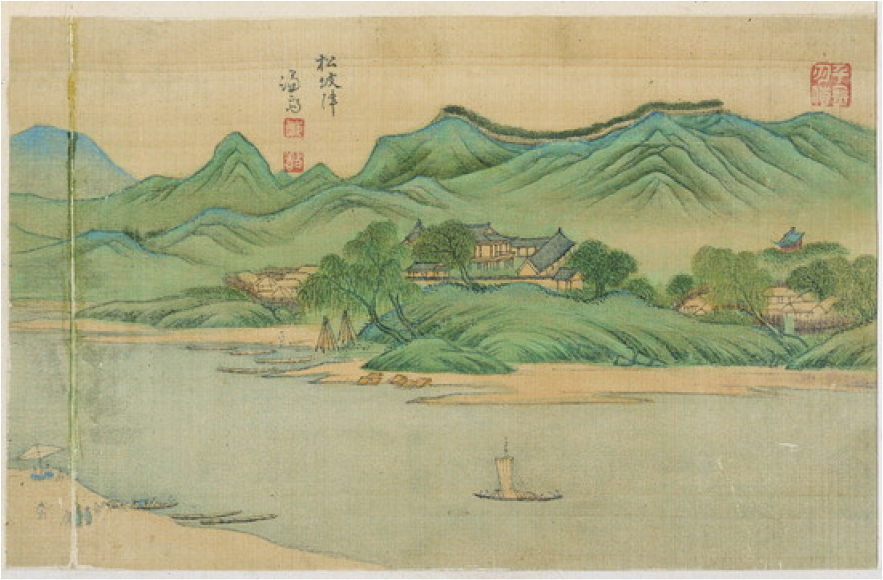
- This study investigates the timing, driving mechanisms, and river responses associated with the white-to-green river transition observed in alluvial sandy rivers in Korea. Historically, rivers on the Korean Peninsula were predominantly characterized as “white rivers,” with exposed sand and gravel bars under high disturbance regimes. In recent decades, however, these systems have undergone a marked transition toward “green rivers,” where herbaceous and woody vegetation has expanded across channel bars, banks, and floodplains. This transformation has dual implications: it reduces channel conveyance capacity and increases flood risk from an engineering perspective, while simultaneously enhancing ecological functions such as biodiversity and habitat complexity. Based on an integrated analysis of historical documents, aerial imagery, and contemporary research, the results indicate that favorable conditions for vegetation recruitment on the sand bars emerged in the late 1970s. These changes were primarily driven by reduced sediment supply associated with watershed reforestation and diminished flood disturbances following the construction of multipurpose dams. Widespread vegetation establishment and expansion became evident from the early 1990s. In sand-bed rivers, which are common in Korea, dam-induced attenuation of flow variation and flood disturbance played a dominant role in accelerating vegetation encroachment. Meanwhile, unregulated rivers appear to maintain seasonal hydroclimatic variability, creating intermittent “windows of opportunity” for vegetation recruitment. These findings demonstrate that riparian vegetation change is not merely an ecological response but a bio-morphological process coupled with flow, sediment, and vegetation. Under future climate change scenarios, shifts in the magnitude and frequency of extreme hydrological events are expected to significantly alter riparian vegetation regimes. This underscores the need for adaptive, long-term river management strategies that explicitly incorporate vegetation-flow-sediment feedbacks.
- COLLAPSE
본 연구는 국내 충적하천에서 관찰되는 ‘백색하천에서 녹색하천으로의 천이(white-to-green river transition)’ 현상의 시기, 구동요인 및 하천반응 특성을 규명하는 것을 목적으로 한다. 과거 한반도의 하천은 모래, 자갈이 노출된 교란 상태의 백색하천이 지배적이었으나, 최근에는 강턱, 사주 및 홍수터에 초본 및 목본 식생이 확장된 녹색하천으로 전환되고 있다. 이러한 변화는 하도 통수능 저하 및 홍수위험 증가라는 공학적 문제를 야기하는 동시에, 생물다양성 증진과 서식처 다양성 확보라는 생태적 기능을 수반하는 이중적 특성을 가진다. 역사기록, 항공사진 및 최근 연구성과를 종합적으로 분석한 결과, 1970년대 후반 유역 산림녹화에 따른 토사공급 감소와 다목적댐 건설에 따른 홍수교란 완화로 식생 이입·활착에 유리한 조건이 형성되기 시작한 것으로 나타났다. 이후 1990년대 초부터 식생의 본격적인 이입 및 확장이 진행된 것으로 판단된다. 국내에 흔한 모래하천은 댐에 의한 유량 변동성 감소와 홍수교란 약화가 식생 확장을 지배하는 주요 요인으로 작용하는 것으로 나타났다. 비조절하천에서도 계절적 강우-유출 변동성이 ‘기회의 창’을 형성하여 식생 이입을 간헐적으로 촉진하는 것으로 해석된다. 이러한 결과는 하천식생 변화가 단순한 생태적 현상이 아니라 흐름-유사-지형-식생 간 상호작용에 의해 지배되는 통합적 생물지형학적 과정임을 보여준다. 향후 기후변화에 따른 극한 수문사상의 변화는 수변식생레짐에 중대한 영향을 미칠 것으로 예상되며, 이를 반영한 장기적·적응적 하천관리 전략 수립이 요구된다.
-
An analysis of historical riparian vegetation regime shifts in Korea: Drivers, processes, and implications of the white-to-green river transition
-
Research Article
-
Assessing delayed vegetation responses to agricultural drought using time-series planetscope imagery
시계열 PlanetScope 영상을 활용한 농업가뭄 식생 반응 및 지연 특성 분석
-
Hyeok-Jae Choi, Won-Ho Nam, Hee-Jin Lee, Min-Gi Jeon, Jeonghwan Park, Eunmi Hong, Minkyu Moon
최혁재, 남원호, 이희진, 전민기, 박정환, 홍은미, 문민규
- Recent climate change has increased the frequency and severity of droughts, resulting in intensified agricultural damage. In particular, upland crops that rely …
최근 기후변화의 영향으로 가뭄의 발생 빈도와 강도가 증가하면서 농업 피해가 확대되고 있다. 특히 국내 밭 농업은 물 공급을 주로 강우에 의존하고 있어 …
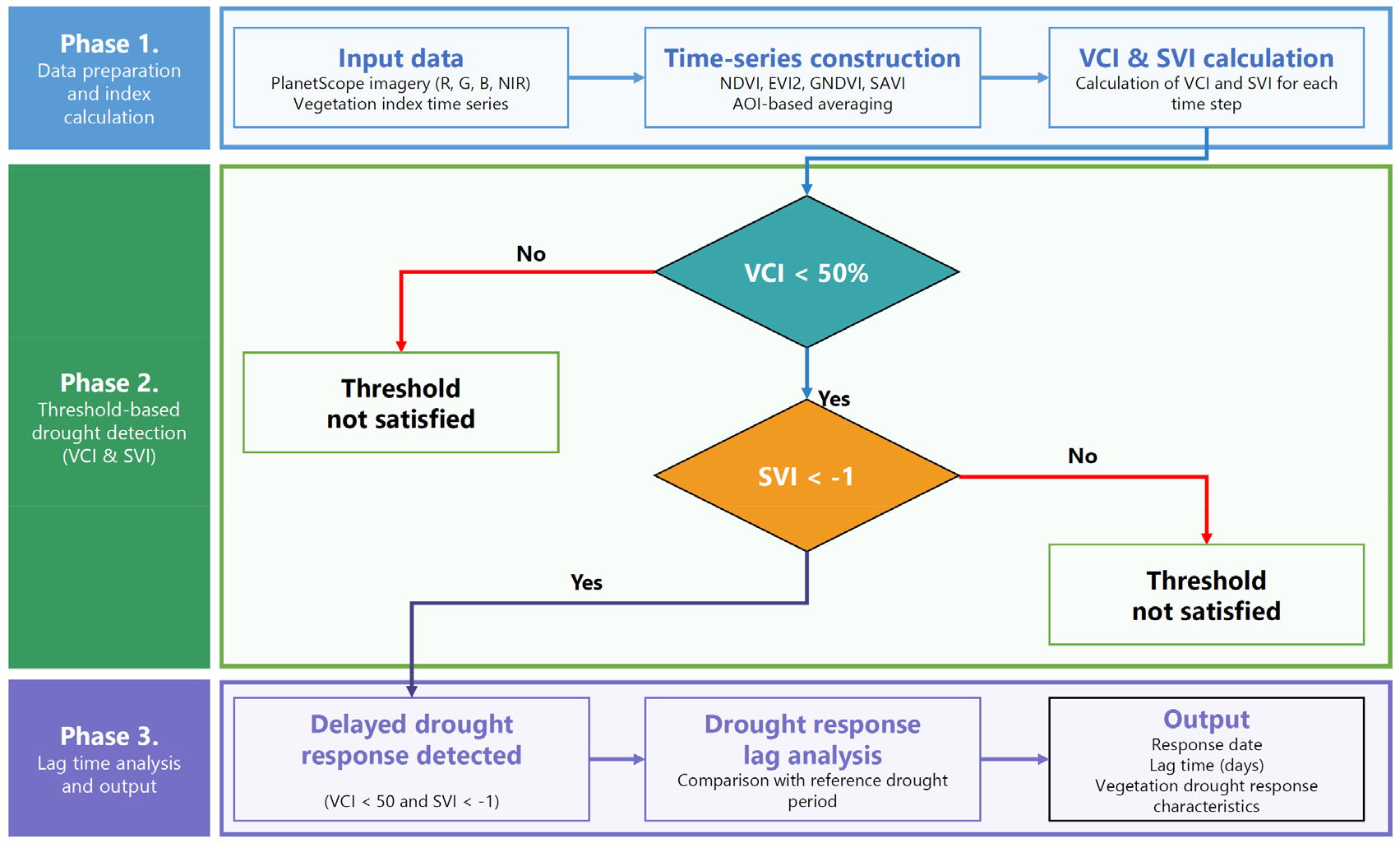
- Recent climate change has increased the frequency and severity of droughts, resulting in intensified agricultural damage. In particular, upland crops that rely primarily on rainfall are highly vulnerable to drought stress and may experience substantial reductions in productivity. This study investigated the potential of high-resolution PlanetScope time-series imagery for agricultural drought monitoring in South Korea. Using PlanetScope imagery acquired over Changnyeong-gun, Gyeongsangnam-do, in 2018, NDVI, EVI2, GNDVI, and SAVI were derived and compared with MODIS vegetation indices to evaluate their temporal consistency and response characteristics. In addition, the Vegetation Condition Index (VCI) and Standardized Vegetation Index (SVI) were calculated from the vegetation index time series, and the first date satisfying both drought-threshold conditions was defined as the vegetation drought response date. The results showed that NDVI, EVI2, and SAVI exhibited high coefficients of determination with MODIS, while GNDVI also showed statistically significant relationships. The detected vegetation drought response occurred approximately 64-70 days after the end of the reference drought period, indicating a delayed decline in vegetation condition that may reflect both accumulated water stress and seasonal vegetation dynamics. These findings suggest that PlanetScope-based vegetation indices can support the analysis of delayed vegetation-condition changes within the study area, although the detected responses may reflect both cumulative water stress and seasonal vegetation dynamics.
- COLLAPSE
최근 기후변화의 영향으로 가뭄의 발생 빈도와 강도가 증가하면서 농업 피해가 확대되고 있다. 특히 국내 밭 농업은 물 공급을 주로 강우에 의존하고 있어 가뭄에 매우 취약하며, 필지 규모가 작은 국내 농업 환경에서는 중·저해상도 위성자료만으로 농경지 단위의 식생 변화를 정밀하게 파악하는 데 한계가 있다. 이에 따라 본 연구에서는 고해상도 PlanetScope 시계열 영상을 활용하여 국내 농업가뭄 모니터링 적용 가능성과 식생 기반 가뭄 반응 특성을 분석하였다. 연구 대상 지역은 경상남도 창녕군으로 선정하였으며, 2018년 PlanetScope 영상으로부터 NDVI, EVI2, GNDVI, SAVI를 산정하였다. 또한 동일 시기의 MODIS 식생지수와 비교하여 PlanetScope 기반 식생지수의 시계열 일관성과 반응 특성을 검토하였다. 더불어 Vegetation Condition Index (VCI)와 Standardized Vegetation Index (SVI)를 산정하고, 두 임계조건을 동시에 만족하는 최초 시점을 식생 기반 가뭄 반응 시점으로 정의하여 기준 가뭄 기간과 비교하였다. 분석 결과, NDVI, EVI2, SAVI는 MODIS와 높은 결정계수를 나타냈으며, GNDVI 역시 통계적으로 유의한 관계를 보였다. 또한 식생 기반 가뭄 반응 시점은 기준 가뭄 종료 이후 약 64∼70일의 지연을 두고 나타났으며, 이는 산정된 식생 저하 시점이 기준기간 이후 일정한 시차를 두고 나타났음을 보여주며, 누적 수분 스트레스와 계절적 생육 변화가 함께 반영되었을 가능성이 있다. 본 연구 결과는 PlanetScope 기반 식생지수가 연구지역 농경지의 평균적인 식생 변화와 가뭄 반응 시점을 분석하기 위한 자료로 활용될 가능성을 보여준다.
-
Assessing delayed vegetation responses to agricultural drought using time-series planetscope imagery
-
Research Article
-
A study on prediction of seawater intrusion in coastal aquifers in Korea using the LSTM model
LSTM 모델을 이용한 국내 해안 지역 대수층 내 해수 침투 예측에 관한 연구
-
Mincheol Kim, Jaehyun Bae, Woochang Jeong
김민철, 배재현, 정우창
- Seawater intrusion is a phenomenon that causes salinization of freshwater resources in coastal aquifers, and it is a key management concern in …
해수 침투는 연안 대수층에서 담수 자원의 염분화를 유발하는 현상으로, 장기적인 지하수 이용 안정성과 수자원 관리 측면에서 중요한 관리 대상이다. 그러나 해수 침투 …
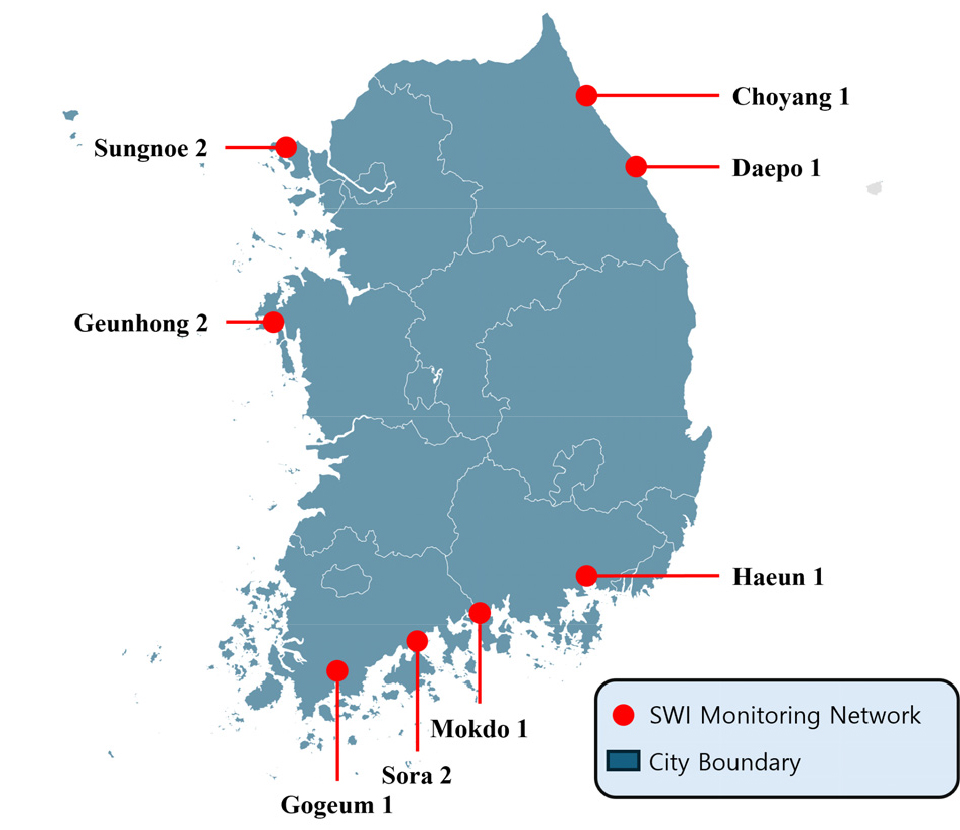
- Seawater intrusion is a phenomenon that causes salinization of freshwater resources in coastal aquifers, and it is a key management concern in terms of the long-term stability of groundwater use and water resource management. However, since seawater intrusion is influenced by a combination of factors—including tides, precipitation, fluctuations in groundwater levels, and anthropogenic pumping—there are limitations to long-term predictions based solely on existing physics-based numerical models. In particular, the variability and uncertainty of field observation data are major factors that compromise the accuracy of seawater intrusion predictions. To address these limitations, this study aimed to predict the extent of seawater intrusion by utilizing long-term time-series data on electrical conductivity (EC) collected from groundwater monitoring stations in coastal areas of South Korea. By applying the LSTM (Long Short-Term Memory) model, which excels at learning long-term time-series dependencies, to the Haeun 1 and Mokdo 1 stations in the Gyeongnam region, the Gogum 1 and Sora 2 stations in the Jeonnam region, Daepo 1 and Joyang 1 in Gangwon Province; and Sungnoe 2 and Geunhong 2 in Incheon and South Chungcheong Province. After training the model on 70.0% of the total 3,437 time-series data points collected from January 1, 2014, to May 31, 2023, the model’s performance in predicting seawater intrusion was analyzed using the remaining 30.0%. Predictions made using an LSTM model based on long-term time-series EC data generally effectively captured the trends in seawater intrusion variability; however, differences in prediction performance were observed depending on the characteristics of variability by region and dataset. While the model demonstrated stable predictive performance in regions with relatively low volatility, it was found that prediction errors tended to increase at observation stations where sharp rises and falls occurred frequently.
- COLLAPSE
해수 침투는 연안 대수층에서 담수 자원의 염분화를 유발하는 현상으로, 장기적인 지하수 이용 안정성과 수자원 관리 측면에서 중요한 관리 대상이다. 그러나 해수 침투 현상은 조석, 강수, 지하 수위 변동과 인위적 양수 등의 복합적인 요인에 의해 기존의 물리적 기반 수치모델만으로 장기 예측에 한계가 있다. 특히 현장 관측 자료의 변동성과 불확실성은 해수 침투 예측의 정확도를 저해하는 주요 요인으로 작용한다. 본 연구에서는 이러한 한계를 보완하기 위해 국내 해안 지역 지하수 관측소에서 장기간 측정된 전기전도도(Electrical Conductivity, EC) 시계열 자료를 활용하여 해수 침투 정도를 예측하고자 하였다. 장기 시계열 의존성 학습에 강점을 가지는 LSTM (Long Short-Term Memory) 모델을 적용하여 경남지역 해운 1과 목도 1, 전남지역 고금 1, 소라 2, 강원지역 대포 1, 조양 1 그리고 인천 및 충남지역 숭뇌 2, 근홍 2 관측소의 2014년 1월 1일부터 2023년 5월 31일까지 총 3,437개의 시계열 데이터 중 70.0 %를 학습시킨 후 30.0 %를 해수 침투 예측 특성을 분석하였다. 장기 시계열 EC 자료를 활용한 LSTM 모델을 통한 예측은 전반적으로 해수 침투 변동 경향을 효과적으로 모사하였으나, 지역별·자료별 변동성 특성에 따라 예측 성능 차이가 확인되었다. 변동성이 상대적으로 작은 지역에서는 안정적인 예측 성능을 보인 반면, 급격한 상승·하강이 빈번한 관측소에서는 예측 오차가 증가하는 경향이 확인되었다.
-
A study on prediction of seawater intrusion in coastal aquifers in Korea using the LSTM model
-
Research Article
-
Analysis of wind effects on river surface velocity and evaluation of wind correction coefficient applicability
하천 표면유속의 바람영향 분석 및 바람보정계수 적용성 평가
-
Sinjae Lee, Seokgeun Park, Bokjin Jang, Geunsoo Son
이신재, 박석근, 장복진, 손근수
- As the use of non-contact surface velocimeters for river discharge measurement has increased, it has become increasingly important to consider external factors …
최근 비접촉식 표면유속계를 이용한 하천 유량측정이 확대됨에 따라 표면유속에 영향을 미치는 외부 요인에 대한 고려가 중요해지고 있다. 특히 바람은 표면유속을 변화시키는 주요 …
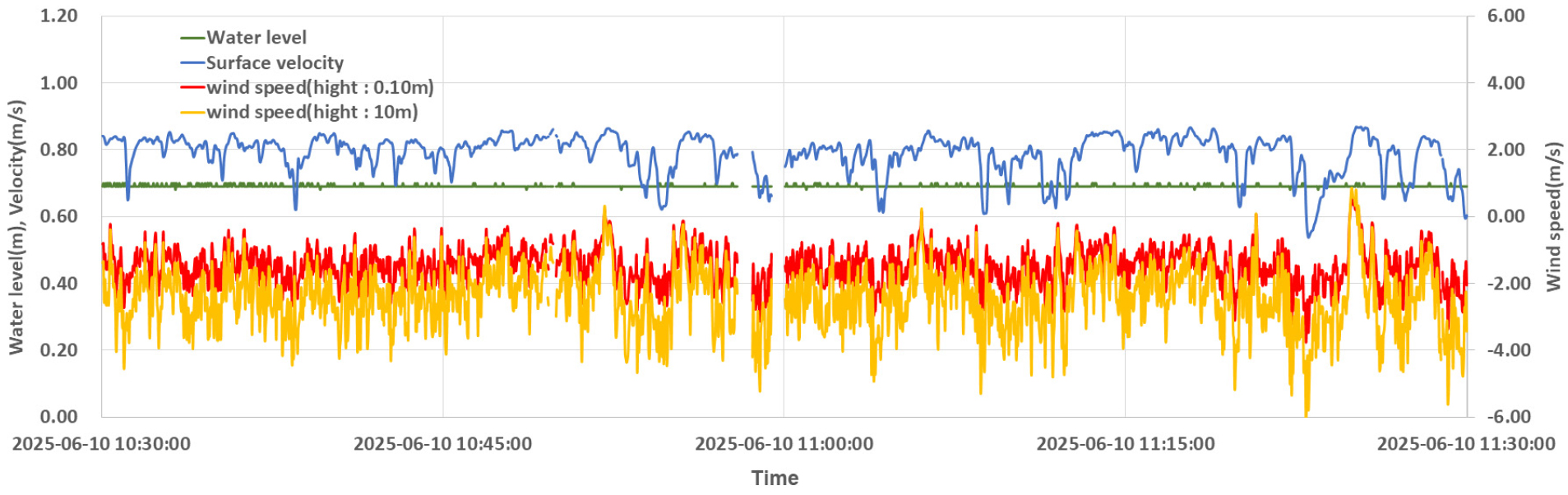
- As the use of non-contact surface velocimeters for river discharge measurement has increased, it has become increasingly important to consider external factors affecting surface velocity. Among these factors, wind is a major contributor to variations in surface velocity and may introduce errors in velocity and discharge measurements if not properly accounted for. This study investigated the effect of headwind conditions on river surface velocity through experiments conducted in an experimental channel. The results showed that the change in surface velocity corresponded, on average, to 3.3% of the wind speed measured at a height of 10 m above the water surface, yielding a wind correction coefficient of 0.033. The derived wind drift coefficient was applied to the Hongcheon Station (Hongcheon Bridge) on the Hongcheon River, where an automatic discharge measurement system based on a radar surface velocimeter is installed. Surface velocities measured by the radar surface velocimeter were corrected using the proposed coefficient, and the mean velocities estimated by the Index Velocity Rating Curve Method (IVRC) were compared with those derived from the Stage-Discharge Rating Curve (HQRC). As a result, the RMSE decreased by 25%, from 0.04 m/s to 0.03 m/s. In addition, the temporal variation of the corrected mean velocity showed better agreement with the HQRC-based mean velocity than that of the uncorrected velocity. These results demonstrate the importance of accounting for wind effects in surface-velocity-based discharge measurements and confirm the applicability of the proposed wind correction coefficient under field conditions.
- COLLAPSE
최근 비접촉식 표면유속계를 이용한 하천 유량측정이 확대됨에 따라 표면유속에 영향을 미치는 외부 요인에 대한 고려가 중요해지고 있다. 특히 바람은 표면유속을 변화시키는 주요 인자로, 이를 고려하지 않을 경우 유속 및 유량측정 오차를 유발할 수 있다. 본 연구에서는 실험수로를 이용하여 역풍 조건에서 바람이 표면유속에 미치는 영향을 분석하였다. 그 결과 표면유속 변화량은 수면 기준 10 m 높이 풍속의 평균 3.3%에 해당하는 것으로 나타났으며, 이에 따른 바람보정계수는 0.033으로 산정되었다. 산정된 바람보정계수는 레이더 표면유속계 기반 자동유량측정시스템이 구축된 홍천강 홍천군(홍천교) 지점에 적용하였다. 레이더 표면유속계로 측정한 표면유속에 바람보정계수를 적용한 후 지표유속법(IVRC)으로 산정한 평균유속을 수위-유량관계곡선(HQRC) 기반 평균유속과 비교한 결과, RMSE는 0.04 m/s에서 0.03 m/s로 25% 감소하였다. 또한 보정 후 평균유속의 변동 경향은 HQRC 기반 평균유속과 더욱 잘 일치하는 것으로 나타났다. 이러한 결과는 표면유속 기반 유량측정에서 바람영향 보정의 필요성을 보여주며, 본 연구에서 산정한 바람보정계수의 현장 적용 가능성을 확인할 수 있었다.
-
Analysis of wind effects on river surface velocity and evaluation of wind correction coefficient applicability
-
Research Article
-
GUM-based uncertainty evaluation of discharge measurement using an electromagnetic surface velocimeter
전자파 표면유속계를 이용한 하천 유량 측정의 GUM 기반 불확도 평가
-
Jaehyuk Lee, Kwangtae Choi, Hokun Chung, Sinjae Lee
이재혁, 최광태, 정호근, 이신재
- This study develops a GUM (Guide to the Expression of Uncertainty in Measurement)-based framework for evaluating uncertainty in river discharge measurements using …
본 연구에서는 전자파 표면유속계를 이용한 하천 유량 측정의 신뢰성 확보를 위해 GUM (Guide to the Expression of Uncertainty in Measurement) 기반 불확도 …
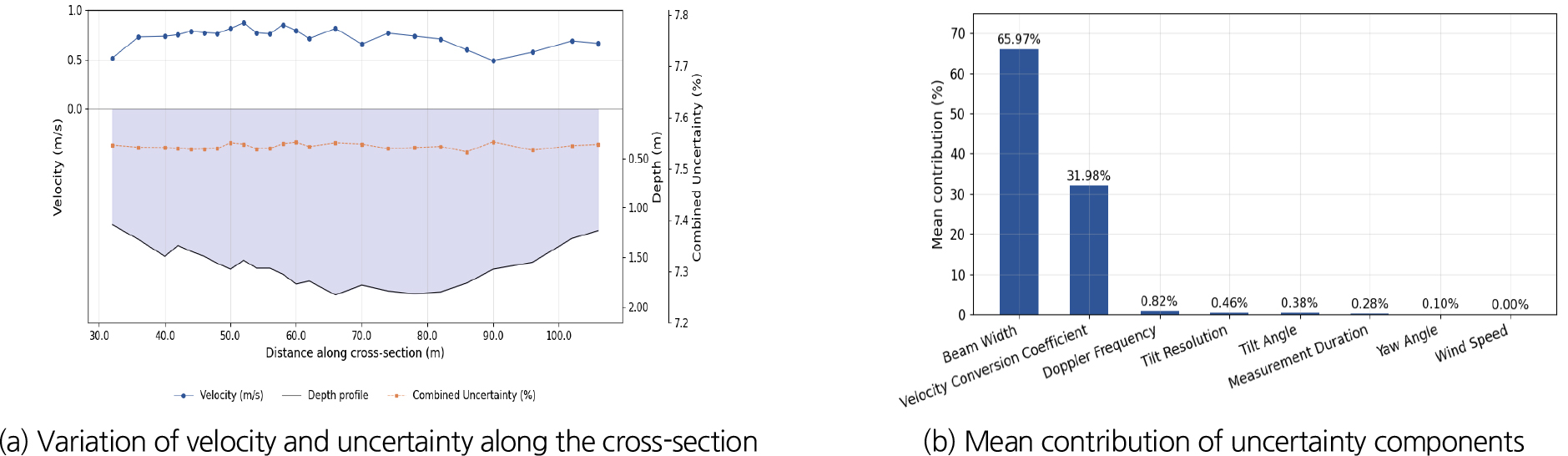
- This study develops a GUM (Guide to the Expression of Uncertainty in Measurement)-based framework for evaluating uncertainty in river discharge measurements using an electromagnetic surface velocimeter (ESV) and examines its applicability through field data. A Doppler-based velocity measurement model was defined, and a comprehensive uncertainty structure was established by incorporating elemental components, including installation and operational conditions, environmental factors, and hydraulic variables. The application of this framework to field data from Pyeongchang Bridge and Hongcheon Bridge resulted in combined standard uncertainties of 2.66% and 2.63% for discharge, respectively, with expanded uncertainties of 5.32% and 5.26% at a 95% confidence level. While the mean velocity uncertainty across verticals was approximately 7%, significant spatial variability was observed, with uncertainty increasing to over 13.76% in low-velocity zones near riverbanks. Contribution analysis revealed that antenna beam width and the velocity conversion coefficient were the dominant factors, collectively accounting for more than 90% of the total uncertainty. These results indicate that the accuracy of ESV-based discharge measurement is primarily governed by the instrument’s physical specifications and the reliability of velocity conversion methods. The proposed framework provides a valid methodology for quantitatively identifying uncertainty sources and improving measurement accuracy in non-contact hydrometry.
- COLLAPSE
본 연구에서는 전자파 표면유속계를 이용한 하천 유량 측정의 신뢰성 확보를 위해 GUM (Guide to the Expression of Uncertainty in Measurement) 기반 불확도 산정 체계를 구축하고, 실측자료를 통해 그 적용성을 검토하였다. 도플러 기반 유속 측정 모델을 정의하고, 설치 및 운용 조건, 환경 요인, 수리학적 요인을 포함한 성분별 불확도 체계를 구성하였다. 평창교 및 홍천교 실측자료 적용 결과, 유량의 합성표준불확도는 각각 2.66%와 2.63%, 확장불확도는 95% 신뢰수준에서 약 5.32%, 5.26%로 나타났다. 측선별 유속 불확도는 평균 7% 수준이었으나, 하안 부근 저유속 구간에서는 불확도가 13% 이상으로 증가하는 공간적 변동성을 확인하였다. 성분별 기여도 분석 결과, 안테나 빔 폭과 유속환산계수가 전체 불확도의 90% 이상을 점유하는 지배적 인자로 파악되었다. 본 연구에서 제안한 체계는 비접촉식 유량 측정의 불확도 발생 원인을 정량적으로 식별하고 계측 정확도를 개선하기 위한 유효한 방법론으로 활용될 수 있다.
-
GUM-based uncertainty evaluation of discharge measurement using an electromagnetic surface velocimeter
-
Research Article
-
Evaluating the impact of rainfall-runoff model modifications on ensemble inflow forecast accuracy: A case study of the Seomjin River Basin
강우-유출 모형 변경에 따른 앙상블 유입량전망 정확도 향상 효과 평가: 섬진강권역 사례
-
Shinuk Kang, Jinhyeog Park, Wansik Yu, Hyungu Choi
강신욱, 박진혁, 유완식, 최현구
- To cope with droughts exacerbated by climate change, this study evaluated the performance of Ensemble Streamflow Prediction (ESP) utilizing the GR4J hydrological …
본 연구는 기후변화로 인한 가뭄에 대응하기 위해, 구조가 간결하고 안정적인 GR4J 수문 모형을 활용한 앙상블 유량전망(ESP)의 성능을 평가하였다. 2022년 극심한 가뭄을 겪은 …
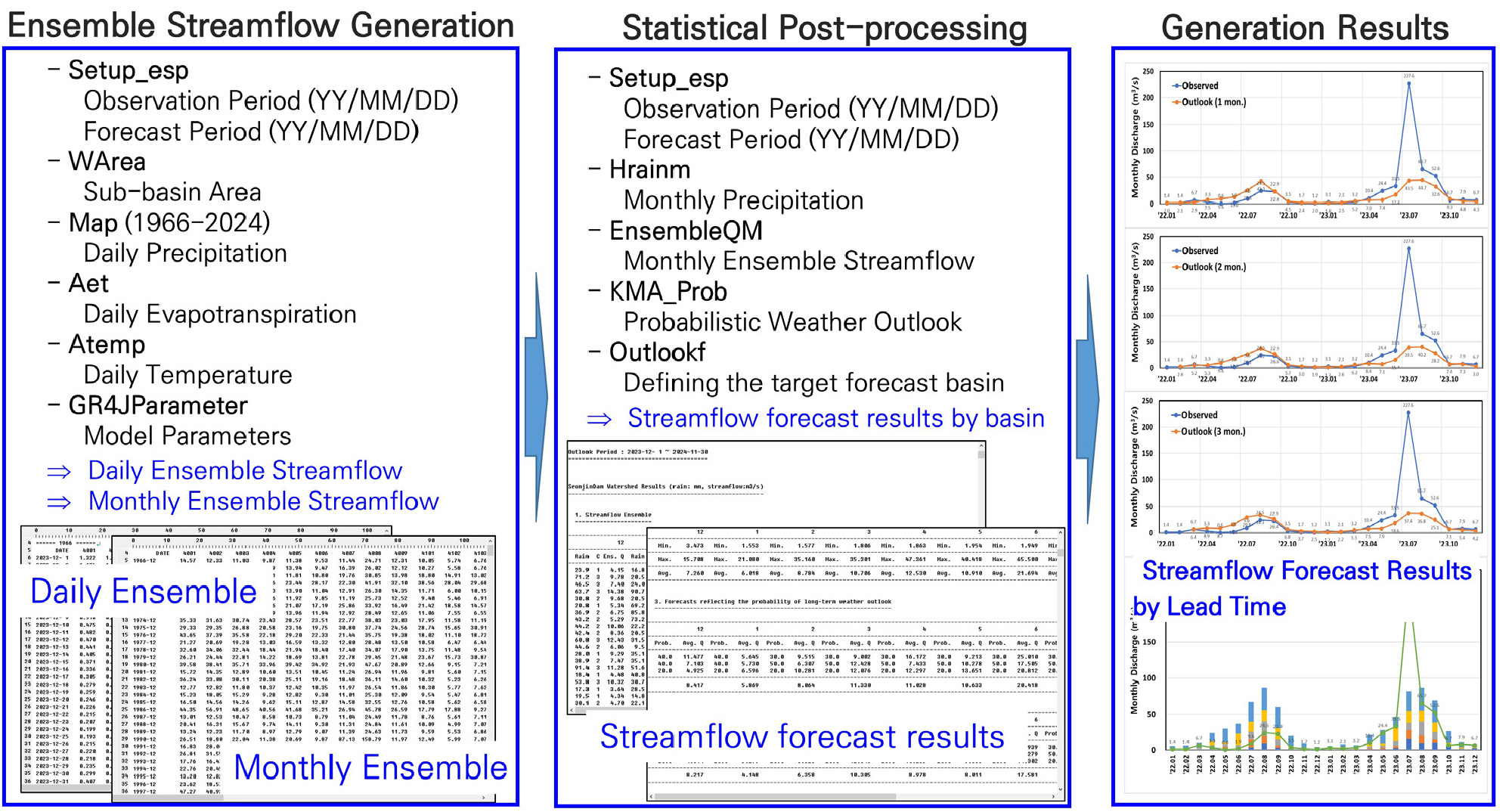
- To cope with droughts exacerbated by climate change, this study evaluated the performance of Ensemble Streamflow Prediction (ESP) utilizing the GR4J hydrological model, known for its simple and stable structure. Based on an analysis of five dams in the Seomjin River basin (Seomjingang, Juam, Juam Regulation, Jangheung, and Pyeongnim Dams) that experienced severe drought in 2022, the GR4J model demonstrated excellent reproducibility by precisely simulating the basin's runoff responses using only a small number of parameters. In particular, compared to the conventional Tank model, the forecasting error (RMSE) was reduced by approximately 8 to 12%, and prediction reliability was significantly improved during low-flow periods without rainfall. In conclusion, the advanced GR4J-based ESP forecasting system reduces the uncertainty of drought predictions and enhances accuracy, which is expected to greatly contribute to the proactive water supply management of multi-purpose dams in the future.
- COLLAPSE
본 연구는 기후변화로 인한 가뭄에 대응하기 위해, 구조가 간결하고 안정적인 GR4J 수문 모형을 활용한 앙상블 유량전망(ESP)의 성능을 평가하였다. 2022년 극심한 가뭄을 겪은 섬진강 권역 5개 댐(섬진강댐, 주암댐, 주암조절지댐, 장흥댐, 평림댐)을 대상으로 분석한 결과, GR4J 모형은 적은 매개변수만으로도 유역의 유출 응답을 정교하게 모사하며 우수한 재현성을 보였다. 특히 기존에 사용되던 Tank 모형에 비해 전망 오차(RMSE)를 약 8~12% 줄였으며, 비가 오지 않는 저유량 구간에서의 예측 신뢰도를 크게 향상시키는 것을 확인하였다. 결론적으로 고도화된 GR4J 기반의 ESP 전망 체계는 가뭄 예측의 불확실성을 낮추고 정확도를 높여, 향후 다목적댐의 선제적인 용수 공급 관리에 크게 기여할 수 있을 것으로 기대된다.
-
Evaluating the impact of rainfall-runoff model modifications on ensemble inflow forecast accuracy: A case study of the Seomjin River Basin
-
Research Article
-
Design of flood-season redefinition and adaptive rule curves for Korea's multipurpose dams under climate change
기후변화 대응 다목적댐 홍수기 재설정과 적응형 Rule Curve 설계
-
Seokhwan Hwang, Narae Kang, Jung Soo Yoon
황석환, 강나래, 윤정수
- Korea's flood-season operating window for multi-purpose dams has been fixed at 92 days (21 June-20 September) for decades. Yet only about 76% …
한국 다목적댐의 홍수기는 6월 21일부터 9월 20일까지 92일로 수십 년간 고정되어 왔다. 그러나 오늘날 극한강수일(지점별 습일(≥1 mm) 일강수량의 상위 5%, 즉 관측기간 …
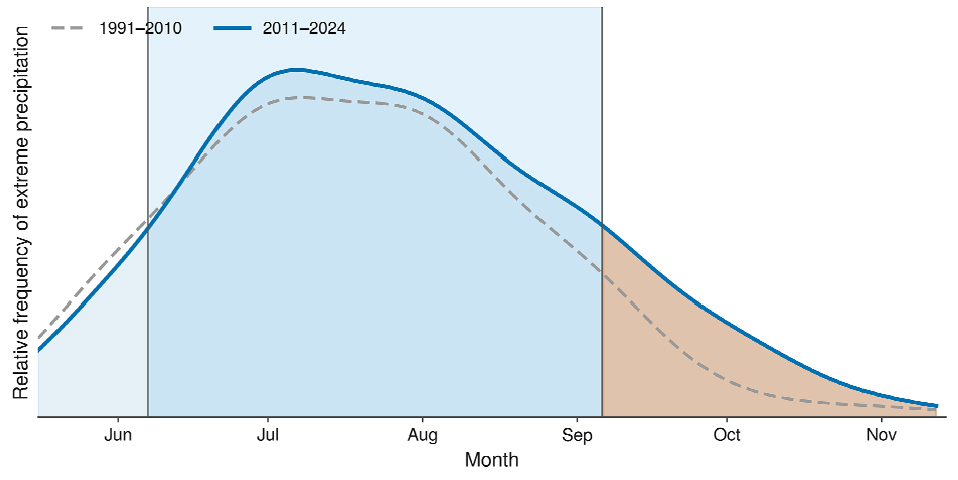
- Korea's flood-season operating window for multi-purpose dams has been fixed at 92 days (21 June-20 September) for decades. Yet only about 76% of extreme-precipitation days (days with daily rainfall at or above the per-station 95th percentile of wet days (≥1 mm), Q₀.₉₅) now fall within this window, so roughly one event in four occurs outside it. Integrating KMA ASOS daily precipitation (61 stations, 1973-2024) and SSP climate scenarios, this study analyses the mismatch along temporal, spatial, and probabilistic axes. Annual maximum daily precipitation shows a marginally significant increasing trend (Mann-Kendall p ≈ 0.07, yet a field-significant signal with 50 of 61 stations increasing); the September-October share of extreme-precipitation days rose from 16% (1991-2010) to 23% (2011-2024) (Wilcoxon p < 0.001); and the share of extreme-precipitation days (2011-2024) captured within the window varies by basin, from 86% (Han) to 70% (Yeongsan), so more vulnerable southern basins have proportionally more extreme days falling outside the flood season. We argue the remedy is not a longer fixed window but a shift away from the fixed-boundary paradigm, and propose an integrated policy of staged temporal extension (110/118/129 days), regional differentiation, and a five-layer adaptive Rule Curve. Under an illustrative cost-benefit analysis, benefits exceed costs several-fold at the central estimate, and the 30-year net present value remained positive across every discount-rate and benefit combination examined here, as well as under the eight-variable tornado and adverse composite-stress tests. The contribution is not a specific monetary figure but the finding that, within the ranges examined, redefining the flood season yields net benefits.
- COLLAPSE
한국 다목적댐의 홍수기는 6월 21일부터 9월 20일까지 92일로 수십 년간 고정되어 왔다. 그러나 오늘날 극한강수일(지점별 습일(≥1 mm) 일강수량의 상위 5%, 즉 관측기간 전체로 산정한 95백분위수 Q0.95 이상인 날) 가운데 약 76%만이 이 기간에 포함되어, 전체의 약 4분의 1이 홍수기 밖에서 발생한다. 본 연구는 기상청 ASOS 일강수(61개소, 1973~2024), SSP 기후시나리오를 통합하여 이 어긋남을 시간·공간·확률의 세 축으로 분석하였다. Mann-Kendall 검정 결과 연 최대 일강수량은 한계적으로 유의한 증가 추세를 보였으며(전국 평균 p ≈ 0.07, 61개 중 50개 지점이 증가하는 field-significant 신호), 9~10월 극한강수일 비율은 16%(1991~2010)에서 23%(2011~2024)로 유의하게 상승하였다(Wilcoxon p < 0.001). 홍수기 안에 드는 극한강수일의 비율(2011~2024)은 권역마다 달라, 한강은 86%인 반면 영산강은 70%에 그쳐, 회복력이 낮고 포함률도 낮은 남부 권역(영산강·섬진강)일수록 극한강수일이 홍수기 밖에서 발생하는 비율이 컸다. 이에 본 연구는 더 긴 고정 기간이 아니라 고정경계 패러다임 자체의 전환, 곧 홍수기 재설정을 제안하며, 단계적 시간 확장(110·118·129일), 권역 차등화, 5계층 적응적 Rule Curve를 통합한 정책을 제시한다. 예시적 비용·편익 분석에서 편익은 중심 추정에서 비용을 여러 배 웃돌았고, 본 연구에서 검토한 할인율(3.0·4.5·5.5%)·편익 정의(보수·중심) 범위와 8변수 토네이도·복합 스트레스 검정 내에서 30년 순현재가치(NPV)는 양(+)으로 유지되었다. 본 연구의 기여는 특정 금액의 제시가 아니라, 검토한 가정 범위에서 홍수기 재설정이 순편익을 발생시킴을 확인한 데 있다.
-
Design of flood-season redefinition and adaptive rule curves for Korea's multipurpose dams under climate change
-
Research Article
-
Numerical simulation and Rouse number-based quantitative analysis of turbulence damping parameter for high-concentration sediment transport in pressurized pipes
관수로 고농도 유사이송의 수치해석 및 난류 감쇠 매개변수의 Rouse 수 기반 정량 분석
-
Yongjun Kwon, Seung Ho Hong, Hyung-Suk Kim
권용준, 홍승호, 김형석
- Three-dimensional numerical simulations of high-concentration fluid-sediment mixture flow in a circular pipe were conducted using the OpenFOAM-based sedInterFoam solver, with the previously …
OpenFOAM 기반 sedInterFoam 솔버를 활용하여 원형 단면 관수로 내 고농도 유체-유사 혼합류에 대한 3차원 수치모의를 수행하였으며, 기존 문헌의 수리실험 결과를 검증 기준으로 …
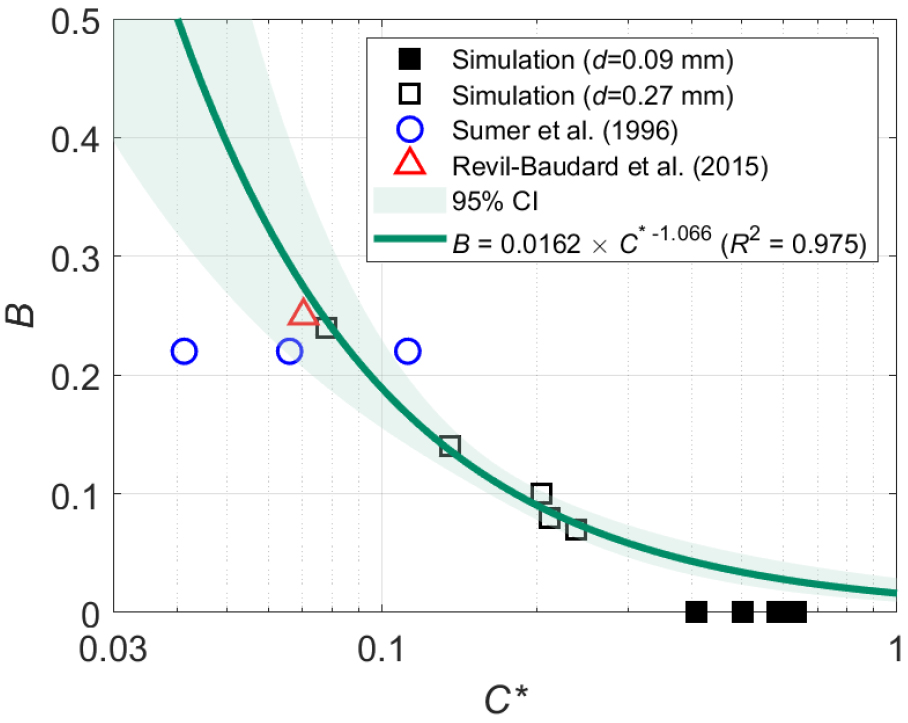
- Three-dimensional numerical simulations of high-concentration fluid-sediment mixture flow in a circular pipe were conducted using the OpenFOAM-based sedInterFoam solver, with the previously reported experimental results adopted as the validation benchmark. The inverse Schmidt number (SUS) specification method and the governing factors of the turbulence damping parameter B were quantitatively investigated. A mesh convergence study was performed under a uniform SUS = 1.0 condition, and the optimal mesh of N5 (982,800 cells) was selected based on a composite assessment of MAPE for both velocity profiles and sediment concentration distributions. A locally computed SUSlocal, derived from a previously published empirical formula, was subsequently applied. For d = 0.09 mm, SUSlocal = 1.016–1.024, deviating from SUS = 1.0 by only 1.6–2.4%, resulting in a marginal improvement in concentration profile accuracy (MAPE: 4.92% → 3.79%). For d = 0.27 mm, SUSlocal = 1.91–3.0 was obtained, and the enhanced turbulent diffusivity substantially alleviated the near-bed concentration over-accumulation, yielding a marked improvement in predictive accuracy (MAPE: 47.98% → 14.70%). The Rouse number was introduced as a sediment transport regime classifier to identify the governing factors of parameter B. In the wash-load regime (Z < 0.8), B ≤ 10-4 was obtained for Z = 0.218–0.269, while a constant value of B ≈ 0.22 was observed for Z = 0.453–0.641. In the suspended- and bed-load dominant regime (Z ≥ 0.8), B varied from 0.07 to 0.24 over Z = 1.645–2.901, exhibiting a stepwise change in the magnitude of B with regime transition. This hierarchical governing structure of B is quantitatively established for the first time under high-concentration sediment transport conditions in a circular pipe. A predictive relationship between the dimensionless sediment concentration C* and B, given by B=0.0162 × (C*)-1.066(R2 = 0.975), is proposed for the Z ≥ 0.8 regime.
- COLLAPSE
OpenFOAM 기반 sedInterFoam 솔버를 활용하여 원형 단면 관수로 내 고농도 유체-유사 혼합류에 대한 3차원 수치모의를 수행하였으며, 기존 문헌의 수리실험 결과를 검증 기준으로 채택하였다. Schmidt 수의 역수(SUS) 산정 방법 및 난류 감쇠 매개변수 B의 지배 인자를 정량적으로 분석하였다. 균일 SUS = 1.0 조건에서 격자 해상도에 대한 수렴성 검토를 수행하였으며, 유속 및 유사 농도 MAPE의 종합 평가를 통해 최적 격자를 결정하였다. 기존 문헌의 경험식에 기반하여 국부적으로 산정하는 SUSlocal을 적용하였다. d = 0.09 mm 조건에서는 SUSlocal=1.016~1.024로 SUS = 1.0과의 차이가 1.6~2.4%에 불과하여 농도 분포 재현성 개선 효과가 제한적이었으며(MAPE 4.92%→3.79%), d = 0.27 mm 조건에서는 SUSlocal=1.91~3.0이 산정되어 난류 확산 증가에 따라 관 하부 집중되는 농도 분포의 완화와 함께 수리실험 재현성이 현저히 향상되었다(MAPE 47.98%→14.70%). Rouse 수(Z = ws/κu*)를 유사 이송 체제 분류 지표로 도입하여 매개변수 B의 지배 인자를 분석하였다. Z < 0.8의 완전부유 체제에서는 Z = 0.218~0.269 범위에서 B ≤ 10-4, Z = 0.453~0.641 범위에서 B ≈ 0.22의 일정한 값이 각각 나타났으며, Z ≥ 0.8의 부유사–소류사 복합 체제에서는 Z = 1.645~2.901에 걸쳐 B=0.07~0.24로 체제 전환에 따라 B의 크기 수준이 단계적으로 변화하였다. 이러한 B의 단계적 지배 구조는 관수로 고농도 유사이송 조건에서 정량적으로 규명되었다. 또한 Z ≥ 0.8 조건에서 무차원 유사 농도 C*와 B의 관계식 B = 0.0162 × (C*)-1.066 (R2=0.975)을 제시하였다.
-
Numerical simulation and Rouse number-based quantitative analysis of turbulence damping parameter for high-concentration sediment transport in pressurized pipes
-
Special Issue: 환경기초조사 / 우수학생논문상
-
Changes in phytoplankton communities and dominant genus succession patterns in Lake Uiam under climatic and aquatic environmental variability
기후 및 수환경 변화에 따른 의암호 식물플랑크톤 군집 구조와 우점속 천이 양상
-
Seonggyeoum Kim, Se yoon Jung, Seungyun Lee, Hyejeong Choi, SangUg Kim, Kyongoh Baek, Eunmi Hong
김성겸, 정세윤, 이승윤, 최혜정, 김상욱, 백경오, 홍은미
- Recent climate change has been accompanied by shifts in phytoplankton community structure and dominant-genera succession in temperate lakes. Artificial reservoirs often show …
최근 기후변화로 인해 온대성 호소에서 식물플랑크톤의 군집 구조와 우점속 교체 양상이 변화하고 있다. 특히 인공호는 유입하천 수질 특성과 종단 구배에 따른 공간적 …
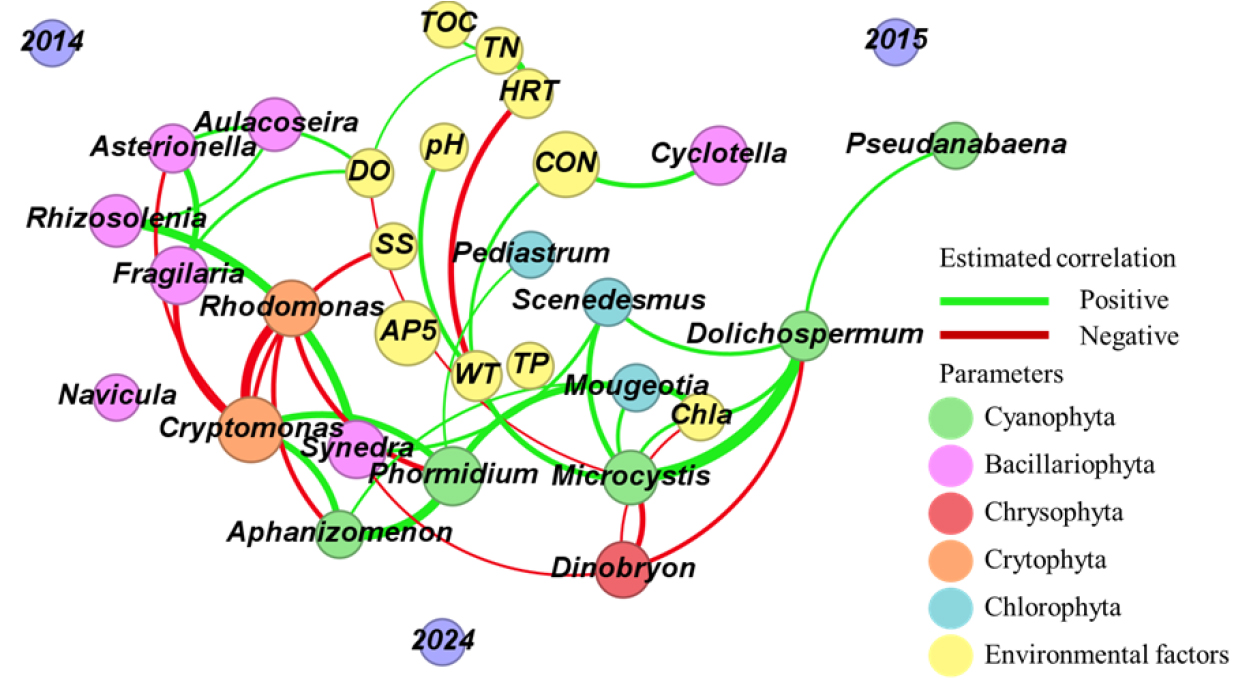
- Recent climate change has been accompanied by shifts in phytoplankton community structure and dominant-genera succession in temperate lakes. Artificial reservoirs often show strong spatial heterogeneity due to differences in inflowing tributary water quality and longitudinal gradients, requiring integrated spatiotemporal assessments of phytoplankton community dynamics. This study compared phytoplankton community data from Lake Uiam in 2014, 2015, and 2024, which had contrasting meteorological and hydrological conditions, to examine how climatic and water-environmental variations were associated with community structure and dominant-genera succession. Water quality analysis showed that Lake Uiam generally maintained mesotrophic conditions throughout the year, with eutrophic conditions occurring during summer and localized eutrophication at some sites. Total phytoplankton abundance in 2024 ranged from 2,172 to 26,116 cells/mL, with the maximum abundance increasing approximately threefold compared with 2014 and 1.8-fold compared with 2015. Dominant genera differed clearly among years. Diatoms continuously dominated in 2014, while in 2015, a temporary summer increase in cyanobacteria (51.0%) was followed by the recovery of diatoms in autumn, broadly corresponding to the typical succession pattern of temperate lakes. In contrast, 2024 showed a distinct sequence of community changes, including Dinobryon dominance in June, enhanced Microcystis dominance during summer, and persistent Phormidium occurrence in autumn, differing from previously reported patterns in the North Han River system. Co-occurrence network and PLS-PM analyses showed that the total effect of climatic factors was approximately 8-13 times greater than that of hydraulic residence time and nutrients, indicating that climatic factors were most strongly associated with community variation. These results suggest that, in mesotrophic to eutrophic waters such as Lake Uiam, climatic variability represented by prolonged high water temperature and intense rainfall may be more closely related to community restructuring and dominant-genera succession than nutrient concentration changes. Although this study is limited by the use of lake-wide mean hydraulic retention time and a relatively small sample size, the findings provide baseline information for climate-adaptive reservoir ecosystem management and algal bloom response strategies.
- COLLAPSE
최근 기후변화로 인해 온대성 호소에서 식물플랑크톤의 군집 구조와 우점속 교체 양상이 변화하고 있다. 특히 인공호는 유입하천 수질 특성과 종단 구배에 따른 공간적 이질성이 크기 때문에 식물플랑크톤 군집 변동을 시·공간적으로 통합 평가할 필요성이 있다. 본 연구는 의암호를 대상으로 기상·수문 조건이 대조적인 2014·2015년과 2024년의 식물플랑크톤 군집 자료를 비교·분석하여, 기후 및 수환경 요인 변동이 군집 구조와 우점속 교체 양상에 미친 영향을 평가하였다. 수질 분석 결과, 의암호는 연중 중영양 상태를 유지하면서 여름철에는 부영양 수준까지 상승하는 경향이 확인되었으며, 일부 정점에서 국지적 부영양화가 두드러졌다. 식물플랑크톤 총현존량은 2024년에 2,172~26,116 cells/mL 범위를 보였으며, 최대 현존량은 2014년 대비 약 3배, 2015년 대비 약 1.8배 증가하였다. 우점속 구성은 연도 간 뚜렷한 차이를 보였다. 2014년에는 규조류가 지속적으로 우점하였고, 2015년에는 하절기 남조류의 일시적 증가(51.0%) 이후 추계 규조류 회복이 나타나 온대 호수의 전형적인 군집 천이 패턴에 비교적 부합하였다. 반면 2024년에는 6월 Dinobryon 우점, 하절기 Microcystis 우점 강화, 추계 Phormidium의 지속 출현이 연속적으로 나타나 기존 북한강 수계에서 보고된 패턴과 구별되는 군집 변동 양상이 확인되었다. 공출현 네트워크 및 PLS-PM 분석 결과, 기후 요인의 총효과가 체류시간 및 영양염에 비해 약 8~13배 크게 나타나, 기후 요인이 군집 변동과 가장 강하게 연관된 요인임이 확인되었다. 이는 의암호와 같이 중영양~부영양 수준에 도달한 수역에서는 영양염 농도 변화보다 고수온 지속과 집중강우로 대표되는 기후 변동성이 군집 구조 재편 및 우점속 교체와 더 밀접하게 연관될 수 있음을 보여준다. 본 연구는 평균 체류시간 적용과 제한된 표본 수라는 한계를 가지나, 향후 기후변화 대응형 호소 생태계 관리 및 조류 대응 전략 수립을 위한 기초자료로 활용될 것으로 기대된다.
-
Changes in phytoplankton communities and dominant genus succession patterns in Lake Uiam under climatic and aquatic environmental variability
-
Special Issue: 환경기초조사
-
Evaluation and improvement of water environment monitoring networks considering changes in water environment conditions: A case study of the Miho River Basin
물환경 변화 특성을 고려한 물환경측정망 평가 및 개선방안 - 미호강 수계를 중심으로 -
-
Hyundong Hwang, Nayoung Yu, Byeol Choi
황현동, 유나영, 최별
- This study presented an evaluation procedure for reviewing the suitability of existing water environment monitoring networks and deriving candidate sites for new …
본 연구는 물환경 변화 특성을 반영하여 기존 물환경측정망의 적합성을 검토하고 신설·변경 후보지를 도출하기 위한 평가 절차를 제시한 후, 이를 미호강 수계에 적용하여 …
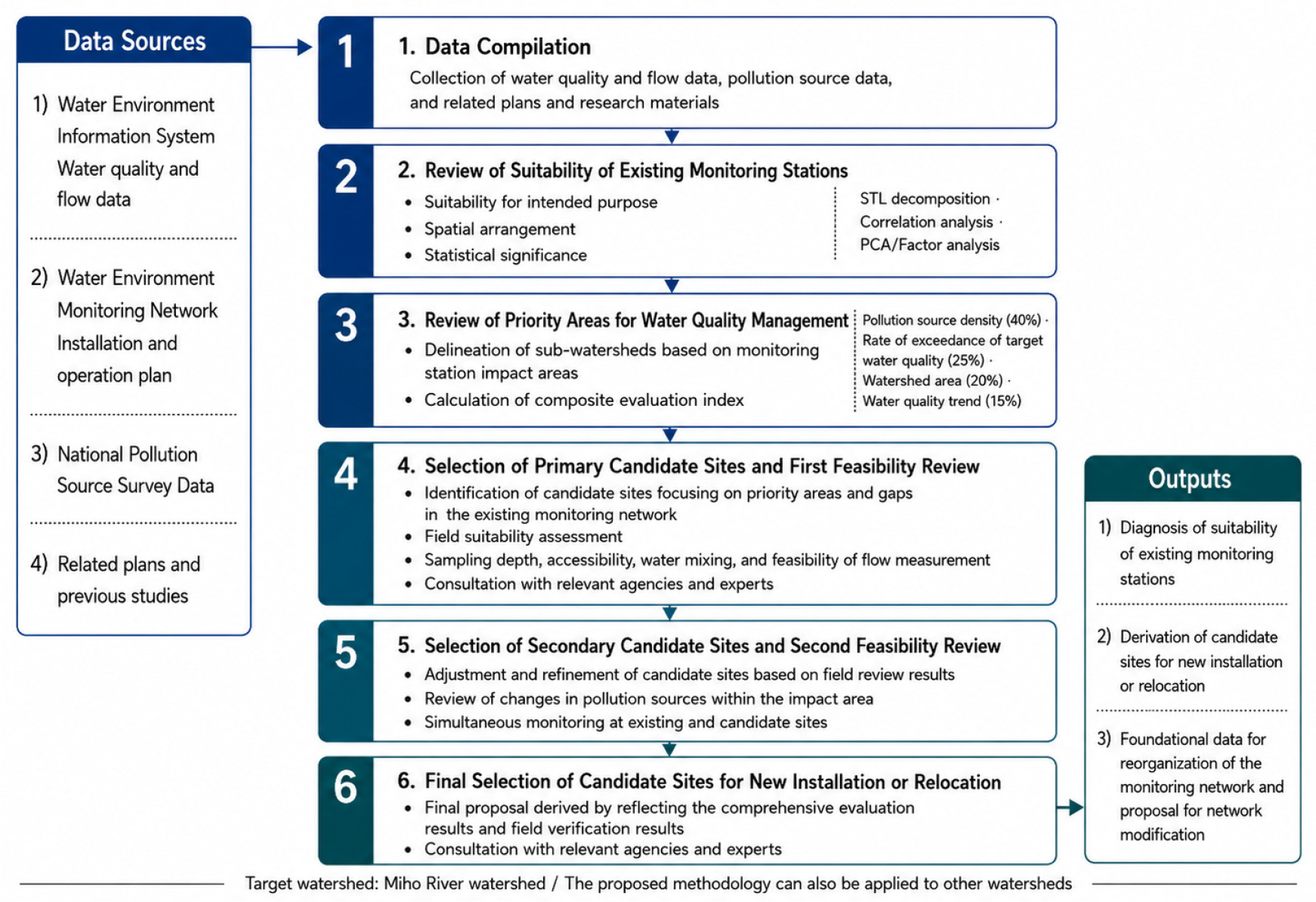
- This study presented an evaluation procedure for reviewing the suitability of existing water environment monitoring networks and deriving candidate sites for new installation or relocation in consideration of changes in the water environment, and then examined its applicability in the Miho River basin. The study was conducted through the following steps: review of the suitability of existing monitoring stations, identification of priority areas for water quality management, selection and feasibility review of candidate sites, and final selection of candidate sites. The suitability assessment showed that, among the 28 existing monitoring stations, 15 were evaluated as suitable and 13 as partially suitable. While a certain degree of information redundancy was observed among consecutive mainstream stations, major tributary outlet stations and stations located immediately upstream of confluences exhibited independent variation characteristics. The composite evaluation of priority areas for water quality management indicated that the Hancheon, Mihogang3, Mihogang2, Mihogang1, and Mihogang6 watersheds had the highest priorities, from which 13 primary candidate sites were derived. Through field investigations and consultation with relevant agencies and experts, these were further refined into seven secondary candidate sites. Changes in pollution sources within the impact area and simultaneous monitoring at existing and candidate sites were then used to evaluate feasibility, resulting in the final selection of five candidate sites. This study proposed a multi-stage evaluation framework that integrates the functional adequacy of the existing monitoring network, redundancy and independence among stations, pollution source distribution, and field operability. The proposed framework can serve as a practical tool for reorganizing water environment monitoring networks in other watersheds as well.
- COLLAPSE
본 연구는 물환경 변화 특성을 반영하여 기존 물환경측정망의 적합성을 검토하고 신설·변경 후보지를 도출하기 위한 평가 절차를 제시한 후, 이를 미호강 수계에 적용하여 활용 가능성을 검토하였다. 연구는 기존 측정망 적합성 검토, 수질관리 우심지역 도출, 후보지 선정 및 타당성 검토, 최종 후보지 선정의 단계로 수행되었다. 기존 측정망 적합성 평가 결과, 기존 측정망 28개 지점 중 15개 지점은 적합, 13개 지점은 부분 적합으로 평가되었으며, 본류 연속 지점들 사이에는 일정 수준의 정보 중복성이 존재한 반면, 주요 지류 말단 및 합류 직전 지점은 독립적인 변동 특성을 나타내었다. 수질관리 우심지역에 대한 종합평가 결과 한천, 미호강3, 미호강2, 미호강1, 미호강6 유역의 우선순위가 높게 나타났으며, 이를 바탕으로 1차 후보지 13개소를 도출하였으며, 현장조사와 관계기관 및 전문가 의견수렴을 거쳐 2차 후보지 7개소를 선정하였다. 기존 지점과 후보 지점의 오염원 변화 및 동시 모니터링을 통해 타당성을 검토하여 최종 후보지 5개소를 선정하였다. 본 연구는 기존 측정망의 기능 적정성, 지점 간 중복성과 독립성, 오염원 분포, 현장 운영 가능성을 통합적으로 고려한 다단계 평가체계를 제시하였으며, 향후 다른 수계의 물환경측정망 재정비에도 적용 가능한 실무적 평가 틀로 활용될 수 있다.
-
Evaluation and improvement of water environment monitoring networks considering changes in water environment conditions: A case study of the Miho River Basin

Journal Informaiton
 Journal of Korea Water Resources Association
Journal of Korea Water Resources Association










 KOREA WATER RESOURECES ASSOCIATION
한국수자원학회
#302 Han-Shin Living Tower, 237 Hyoryeong-ro, Seocho-gu, Seoul 06671, Korea
Tel: +82-2-561-2732 / Fax: +82-2-561-2733 / E-mail: kwra@kwra.or.kr Copyright© KOREA WATER RESOURECES ASSOCIATION. Powered by APUB
Tel: +82-2-561-2732 / Fax: +82-2-561-2733 / E-mail: kwra@kwra.or.kr Copyright© KOREA WATER RESOURECES ASSOCIATION. Powered by APUB

창간호부터 2015년도까지의 자료는 Archives 에서 확인하실 수 있습니다.

CLOSE

창간호부터 2015년도까지의 자료는 Archives 에서 확인하실 수 있습니다.
CLOSE